- Distance
- about 2 km; ul. Piastów Śląskich 1
- Getting there from us
- about 20 minutes on foot through the woods, uphill at the end; 5 minutes by car, but you pay to park at the castle, while parking with us is free
- Time needed
- castle with audio guide about 90 minutes, tunnels 35–45 minutes plus a quarter of an hour's walk from the gate, terraces as long as you like; 3–4 hours for the lot
- With children and dogs
- pushchairs are left where security staff direct you, but a baby carrier worn on the front is fine; tunnels from age 4; dogs (assistance dogs excepted) are not allowed in the castle, on the terraces or in the courtyard — not even on the path to the tunnels and the mausoleum
- Accessibility
- inside the castle a lift serves some of the rooms if you ask at the porter's lodge first; the tunnels are not accessible to wheelchair users or people with limited mobility
Seven hundred years on one rock
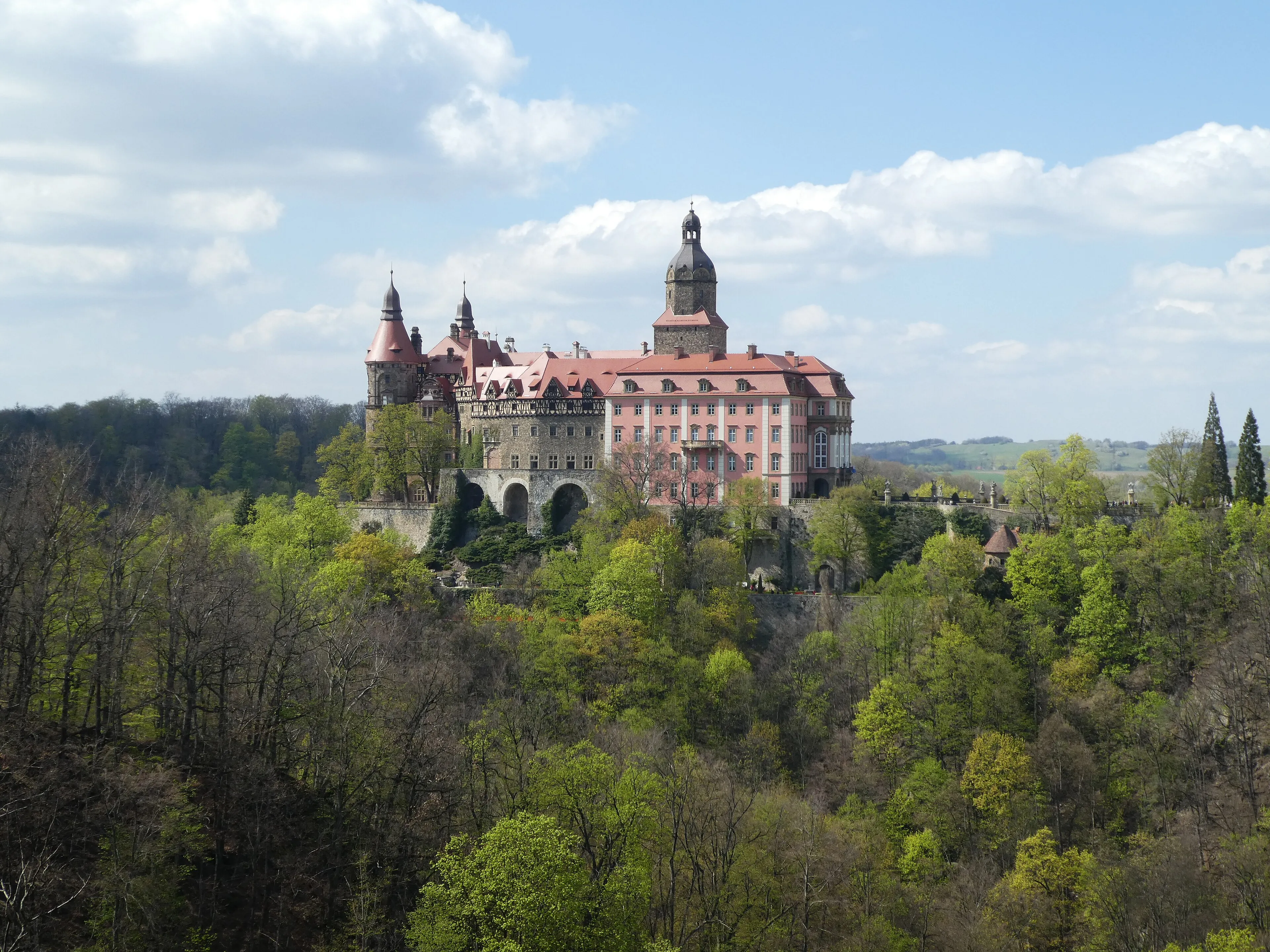
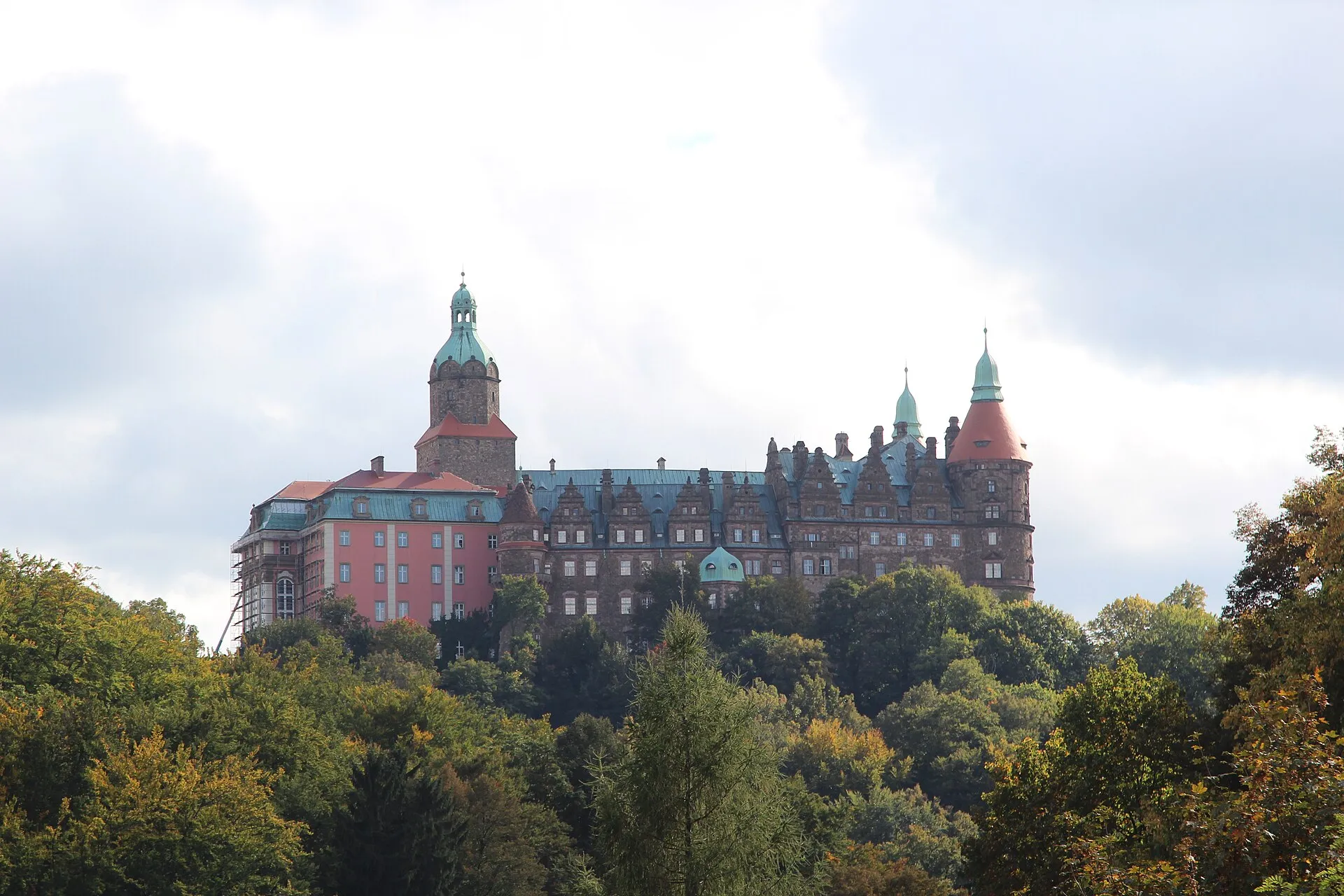
Bolko I the Strict, a Piast duke of Silesia, built a fortress here between 1288 and 1292. From 1509, for more than four hundred years, the castle belonged to the von Hochberg family and went by the German name Fürstenstein — and coal paid for its expansion: the family already owned mines around Wałbrzych in the seventeenth century. Today's Książ is three layers, one on top of another: the medieval core, a baroque remodelling of 1705–1742, and the rebuilding of 1909–1923, which added the west and north wings and raised the tower to 47 metres. It is reckoned to be the third-largest castle in Poland, after Malbork and Kraków's Wawel, and since 2025 it has been a Monument of History (Pomnik Historii). The Nazis refitted the interiors, and after the war Soviet soldiers looted them — among other things they plundered the castle library of more than 64,000 volumes — which is why so many rooms look bare. Come up on foot from below: arrive at the car park by the gate and the sheer scale of the place passes you by.
Without a car: the bus and two ways to the gate
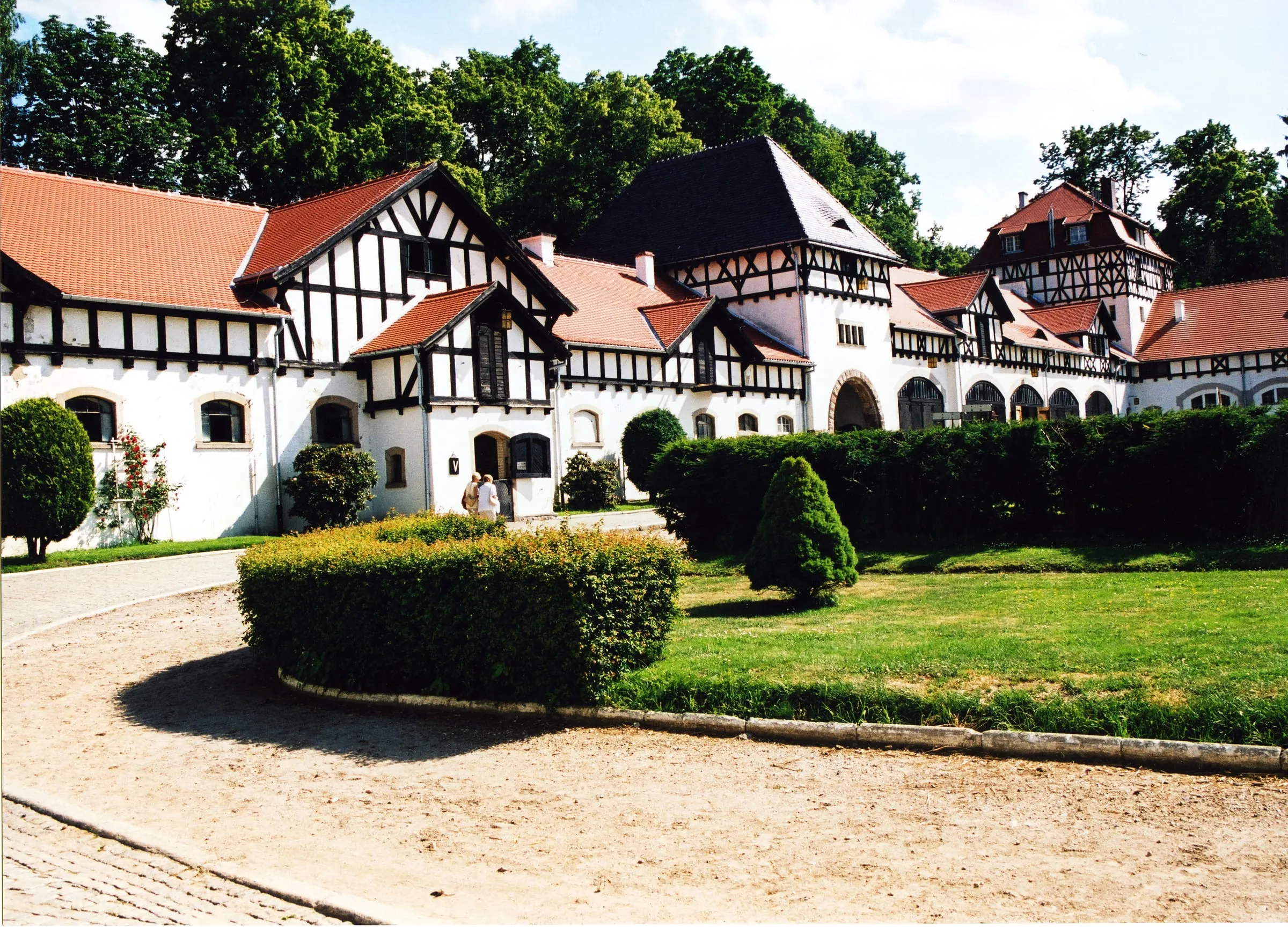
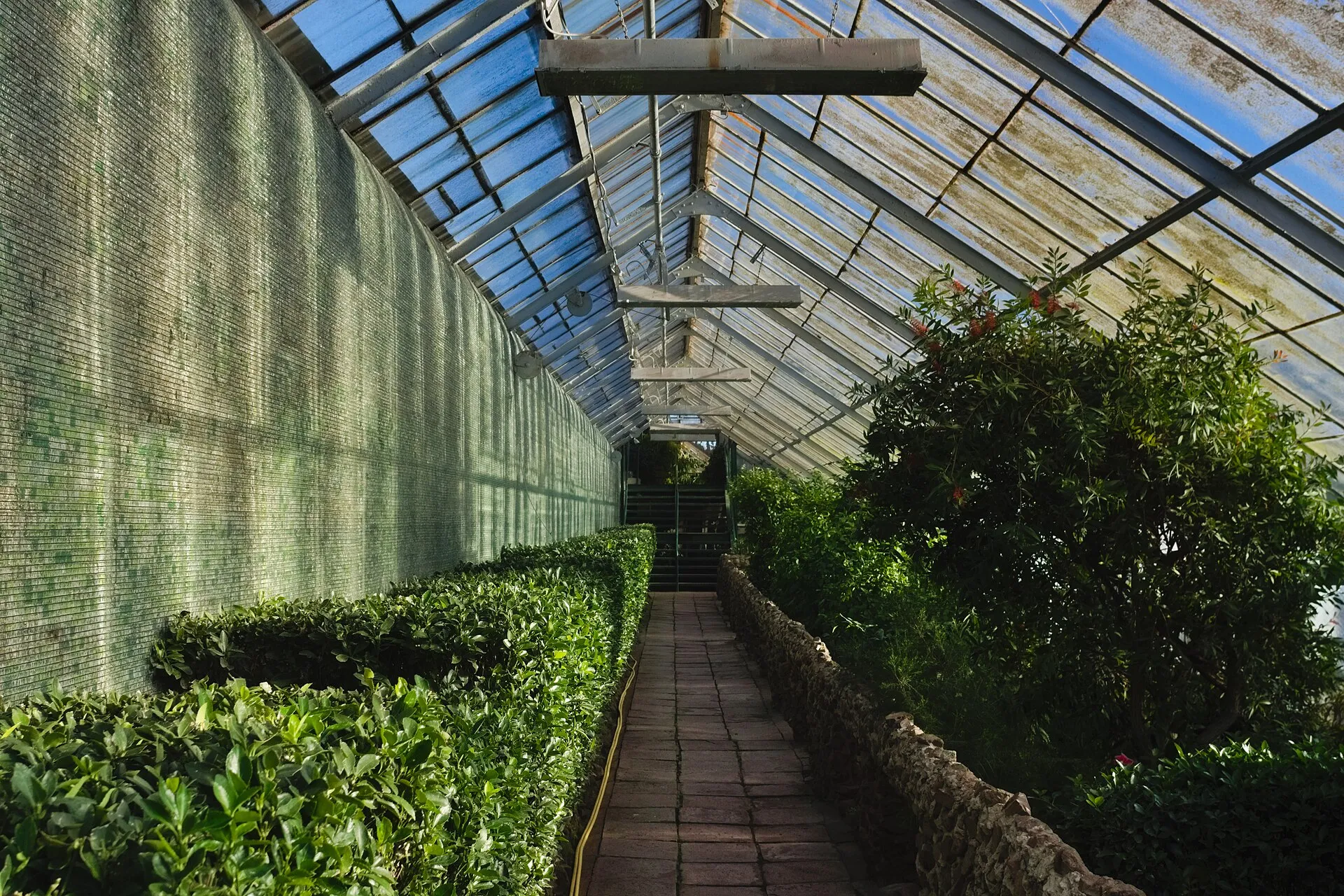
From us the easiest way is on foot: 20 minutes through the woods. If you would rather take the bus, board line 8 or 12 at the “Wrocławska – Fabiana” stop, four minutes from the house – but not every bus runs as far as the castle, so check that the final stop reads “Jeździecka – Zamek Książ”. It is easier to get off at “Jeździecka – Piastów Śląskich” by the stud farm: from there it is 700 m, about 9 minutes on tarmac and gravel through the Ida Gardens (Ogrody Idy), with no steps. The final stop is closer (500 m, 6 minutes), but the way leads over cobbles and stone steps, and the castle advises against it with a pushchair, for older visitors and for people with disabilities. From the palm house the white-and-red waymarked trail leads up to the castle: 2 km, about 25 minutes. Coming by train, buses 9 and 12 stop opposite Wałbrzych Szczawienko station, and 8 and 12 opposite Wałbrzych Miasto. Departures are on rozklad.walbrzych.eu.
Ninety minutes inside, and the golden Maximilian Hall
You go round the castle on your own with an audio guide, with no group to wait for. Besides English, it comes in Polish, German, Czech and Ukrainian, and there is a version in Polish Sign Language; the separate family track for children, however, is in Polish only. The room people remember longest is the Maximilian Hall: gilded, two storeys high, with a ceiling painted by Felix Anton Scheffler in 1732 and fireplaces of black Italian marble. Two of Scheffler's canvases, each almost five metres in size, went missing during the war; since the end of 2025 copies recreated from photographs taken in 1943 have hung in their place. The baroque salons are in the middle of their biggest restoration in half a century, due to run until 2029, so one room or another may be closed. Coats, backpacks and bags go to the cloakroom (a small backpack may be worn on your front); keep your wallet and documents with you. Photography is free, but without flash or a tripod.
Princess Daisy and fourteen terraces
The terraces were laid out in the formal French manner; Princess Daisy brought in British gardeners, who redesigned some of them in the English style. Today there are fourteen, the Rose Terrace among them, along with a cascade fountain. Daisy — Mary Theresa Cornwallis-West, a Briton born in Wales — married Hans Heinrich XV in 1891 and became the most famous of all the ladies of Książ. A school for disabled children in Wałbrzych was set up on her initiative. Her brother was Winston Churchill's stepfather, and Churchill himself came to Książ — the castle names him on its list of famous guests. In 1922 the prince divorced her, in 1941 she had to leave the castle, and she died in 1943 in a villa on what is now ul. Moniuszki in Wałbrzych. The terraces are open from April to September, and in good weather the castle may stretch the season into October — to find out whether they are open on the day, ring the castle on +48 74 66 43 834.
Legends and lore
Princess Daisy's pearls and the grave that isn't there
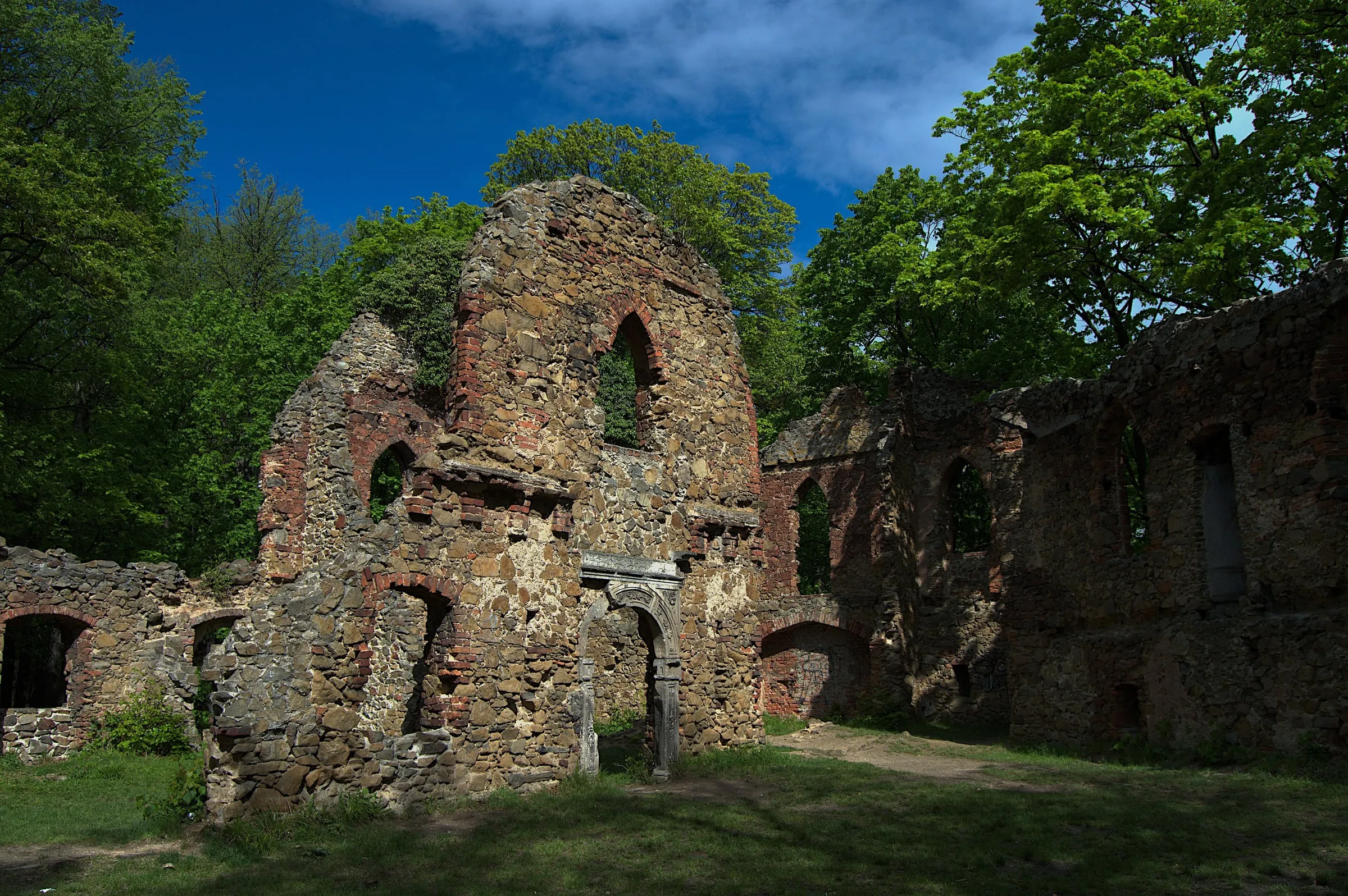
Legend has it that Daisy's pearls were brought up from the sea on an expedition to Africa, and that a young diver paid for them with his life — and ever since, a curse is said to hang over the jewels. Another story says the princess was buried in her pearls, which is why treasure hunters still search for her grave. The diver's tale was most likely invented by Andrzej Konieczny for his sensational 1989 book “Sekrety Białej Damy” (“Secrets of the White Lady”). The facts are humbler: her husband gave her the rope of pearls, over six metres long, in Paris on their honeymoon, and according to National Geographic it was cut up and sold long before her death. In 1943 she was laid to rest in the mausoleum in the castle park; in 1945 Red Army soldiers plundered the tomb, and her servants moved her remains, probably to the Protestant cemetery in Szczawienko, our part of town. The cemetery is long gone; nobody knows where the princess lies.
The castle tunnels: fifty metres below
Between 1943 and 1945, as part of Project Riese, the Nazis converted Książ and drove tunnels into the rock beneath it — perhaps for a headquarters for Hitler, perhaps for a factory; so few documents survive that nobody can say for certain even now. The digging was done by forced labourers and by prisoners from the castle's own subcamp of the Gross-Rosen concentration camp, in operation from May 1944. The stretch open to visitors is about half a kilometre long and lies fifty metres down: a concrete hall, passages in bare rock, and a rockfall where a lift shaft was meant to come up into the Courtyard of Honour. You can only go in with a Polish-speaking guide (visitors from abroad can get an audio guide at the ticket office for an extra charge), at a set time and in limited groups — buy your ticket in advance. The entrance is by the North Terrace, a quarter of an hour's walk from the gatehouse; be there 15 minutes before your time, because latecomers get no refund. Down below it is 6 to 12 °C: bring a jacket and wear flat shoes. You can see other Riese sites at the Walim Adits.
Flower festival, night tours and winter at Książ
Over the long weekend at the start of May the castle holds its Festival of Flowers and Art: floral arrangements in some forty rooms, and enormous queues — so buy your ticket online and walk over from us. The Night Tour usually runs on Fridays and Saturdays: ninety minutes with a guide, by lamplight alone, with ghost stories, staged apparitions and parts of the castle that stay closed by day, such as the Hochbergs' old cellars. It is meant for adults, with separate dates for families, and for individual visitors it is in Polish only. A torch of your own (a phone will do) is compulsory in case the power fails, and for the walk back through the woods after dark bring a head torch — or take the car. In winter the terraces and the mausoleum are closed, but in recent seasons the gardens of the castle and the palm house have been lit up in the evenings as the Gardens of Light (Ogrody Światła).
Opening hours, prices and which routes are running change through the year, so we don't give them here. Check them on the castle's pages for daytime visits (Zwiedzanie dzienne) and the tunnels (Podziemia Zamku), and buy timed tunnel tickets in its online ticket shop.