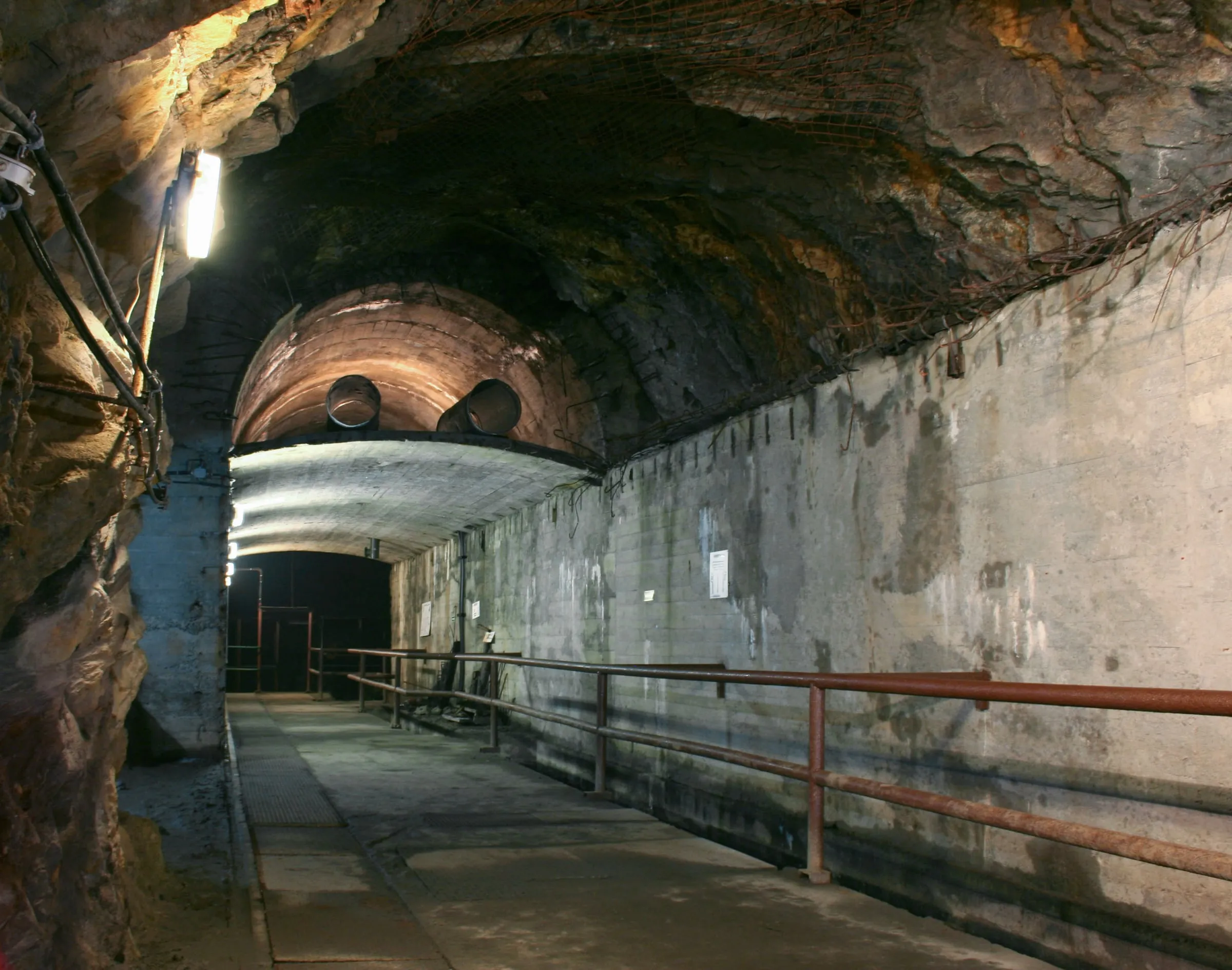
Three parallel tunnels in the side of Mount Ostra, hewn out during the war by forced labourers and prisoners — and never finished. You can only go in with a guide, for about an hour, and underground it is five to seven degrees Celsius all year round.
Distance
about 24 km; Walim, ul. 3 Maja 26 (where Walim meets Rzeczka)
Getting there
about 35 minutes by car via roads 381 and 383; free parking at the adits
Time on site
an hour with the guide, plus the wait to go in — allow 1½ to 2 hours
Suitability
teenagers and adults; 5–7 °C, wet and uneven — bring a jacket, wear closed shoes
Dogs
dogs cannot go into the tunnels (guide dogs excepted)
The adits were cut into the eastern slope of Mount Ostra, about 45 metres apart: some 500 metres of tunnels and chambers in all, with a combined volume of around 14,000 cubic metres. The largest chambers are roughly ten metres high and just as wide, and it is the height that stays with you. Only about 11 per cent of the workings were ever lined with concrete; the rest is raw rock, still bearing the marks of the tunnelling. The three tunnels were originally linked underground, but after rock falls the third is now entered separately — the collapses here are real, not staged for effect. A nearly finished guardroom on the route holds a small exhibition on all the Riese sites. The 13-metre V2 replica by the road and the model V1 illustrate the period, not anything produced here: there is no evidence that rockets were ever built in Riese.
Project Riese: seven sites, no certain answer
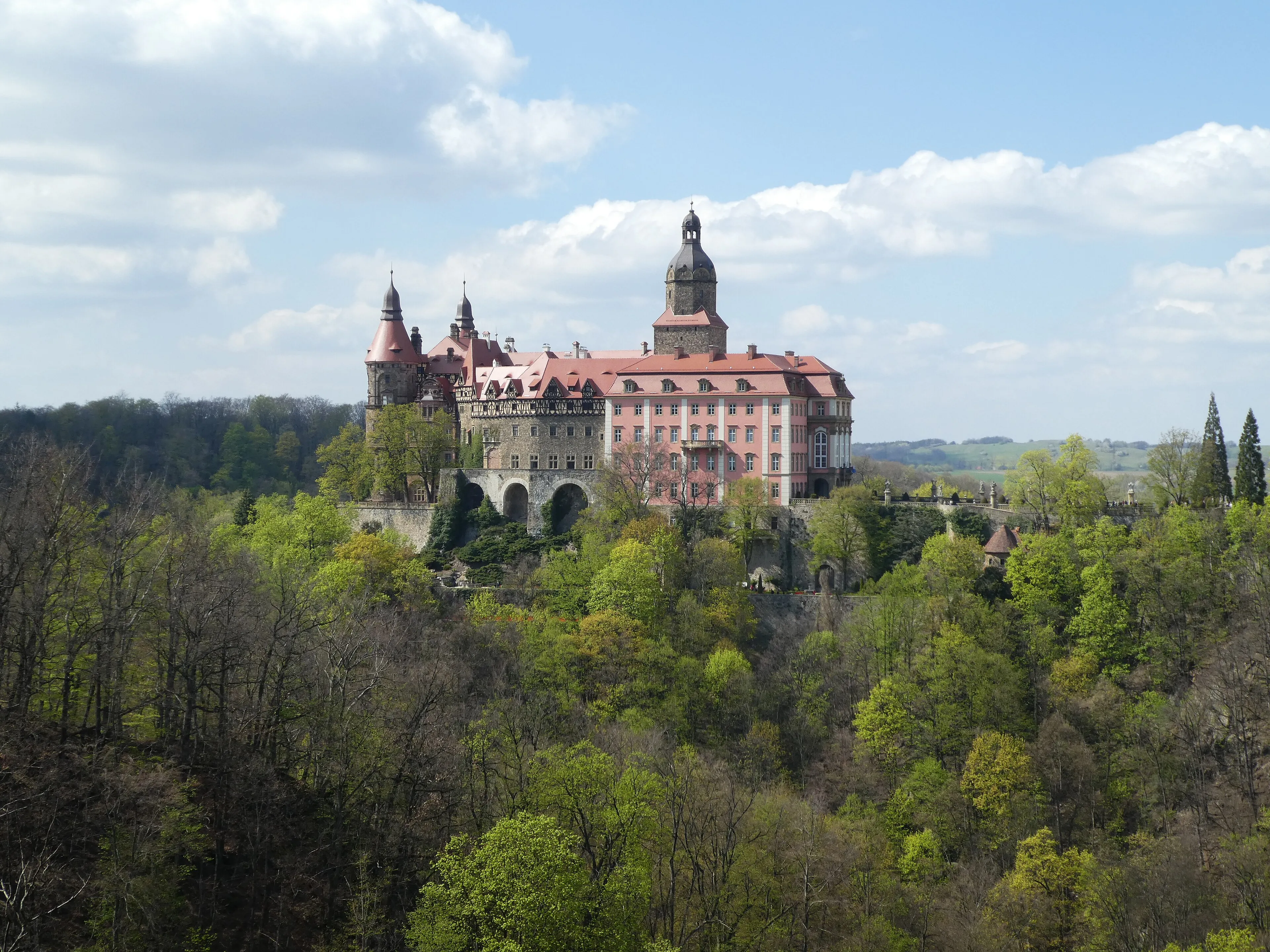
Work under the code name Riese — German for ‘giant’ — began in the Owl Mountains in 1943. It was run at first by the Schlesische Industriegemeinschaft AG, a company headquartered in Jedlina-Zdrój (you drive through it on the way from us), and from April 1944 by Organisation Todt. Rzeczka is one of seven sites, alongside Jawornik, Włodarz, Osówka, Soboń, Gontowa and the tunnels beneath Książ Castle, a 20-minute walk from our house. None was ever finished, few documents survive, and to this day nobody knows what it was all meant for: people most often speak of a headquarters for Hitler, less often of underground armaments factories and laboratories.
Legends and lore
The Amber Room in Project Riese? Tales of treasure behind the rock falls
Local lore still has it that the tunnels open to visitors are only a fraction of Riese, and that behind the rock falls and bricked-up passages lie looted treasure, gold from Wrocław, even the Amber Room. Another story tells of an SS unit said to have stayed on in Rzeczka until May 1945 and to have walled up or blown up the entrances before it left. The facts are more modest: the boreholes treasure hunters drilled in the Walim district in 2015 struck water and mud, and a year later the much-publicised dig for the “gold train” beside the railway in Wałbrzych uncovered nothing. What these mountains really hold is the labour and the deaths of thousands of prisoners.
The people who dug Riese
The first to dig here were forced labourers, mostly from the Soviet Union and Poland, and prisoners of war, most of them Italian and Soviet; from November 1943 they were held in a collection camp in the linen works at Walim. From 26 April 1944, when the first Greek Jews were brought in from Auschwitz, Jewish prisoners of the Gross-Rosen concentration camp, above all from Hungary and Poland, were sent to Riese. Arbeitslager Riese comprised thirteen camps and a hospital camp; one of the camps stood beside Książ. Some 13,000 people passed through them, and at least 4,775 died in the camps. In one of the tunnels hang copies of 49 drawings made in the Dörnhau camp, today’s Kolce, by Imre Holló, a Jewish dentist from Hungary; the captions are in five languages. Slow down as you pass them: they say more about this place than the numbers do.
Guided tour: cold, damp and in Polish
Underground it is 5–7 °C all year round and very damp; in summer, coming in out of the heat, you feel it more than in winter. A jacket and closed shoes with a good grip are essential, not overcautious: the floor can be wet and uneven, the passages narrow and low, the lighting sparse. There are no fixed tour times, and you may wait up to 40 minutes to go in, longer when it is busy. Tickets are usually bought on the spot, as online sales only run on selected days. Groups of more than 20 can book by phone or email. The tours are in Polish, so visitors from abroad will want one of the paid audio guides in English, German, Czech or French. The operator intends the route for teenagers and adults, because of the history told here and the nature of the place; on top of that, darkness, cold and sound effects are not every small child’s idea of fun. With younger children, Osówka, which has an educational route for the very young, is the better choice. With a pushchair or wheelchair, or on crutches, phone the adits before you set off.
Getting there: via Jedlina, Olszyniec and Walim
From us you drive through Wałbrzych on road 381 to Jedlina-Zdrój, then take the 383 through Olszyniec and Jugowice to Walim — about 24 kilometres, roughly 35 minutes. Olszyniec (Erlenbusch) and Walim (Wüstewaltersdorf) both had Riese camps, and you pass through both. In Walim, where the 383 turns off towards the Walim Pass, carry on towards Rzeczka; the way is signposted. For the satnav, enter “ul. 3 Maja 26, Walim”. You will recognise the place by the V2 replica beside the road, and a military Bailey bridge takes you over the Walimka stream to the entrance. Parking is free. You can also walk from Jugowice along the black-waymarked Martyrdom Trail (Szlak Martyrologii), which runs through Walim right up to the adits and on via Osówka and Kolce to the railway station at Głuszyca Górna.
Before you go, check opening hours, ticket prices and visiting rules on the Walim Adits website, and closing days and short-notice changes on its home page, sztolnie.pl — from October to April the adits keep shorter hours. The Gross-Rosen Museum covers the history of the Riese camps.