- Distance
- about 2 km, ul. Jeździecka 3
- Getting there
- a quarter of an hour on foot, the same way as to the castle; at the end you turn into ul. Jeździecka; by bus 8 or 12 to the “Jeździecka – Piastów Śląskich” stop right by the stud
- Time to allow
- half an hour to walk round the stables; longer with a guide or a ride (a lesson lasts 45 minutes)
- Admission
- there is a charge; the stud is sometimes included in a combined ticket with the castle
- Good for
- children (riding from age 10), the afternoon after the castle, competitions in season
The farm a prince turned into stables
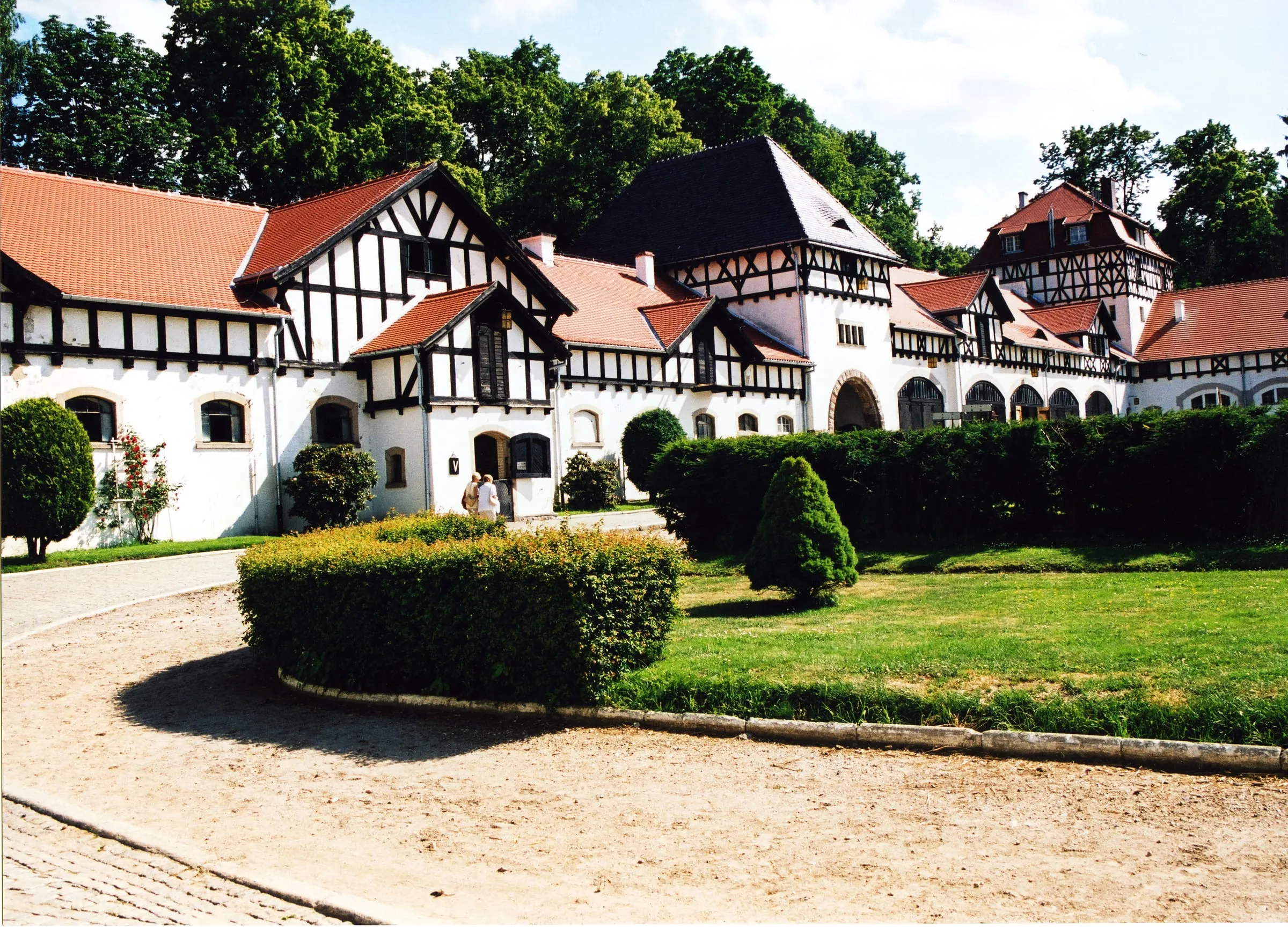
In the 19th century this was a Hochberg home farm, already with buildings for horses. Around 1920 Hans Heinrich XV had it rebuilt and extended: new stables, a covered riding hall, a smithy and even garages for motor cars — almost all of it half-timbered and set around a square courtyard a hundred metres on each side. According to a history of the stud, the riding hall was built of larch without a single nail, and riders check their seat in the mirrors on its walls. The showpiece is Stable III, known as the parade stable and once reserved for black carriage stallions: a barrel vault, a corridor of red tiles, white tiles and the original brass knobs on the posts. Since 2025 the stud has been part of a Monument of History (Pomnik Historii), together with the castle, the park and the palm house.
From the prince's races to a state stud
Hans Heinrich XV loved horses. On his initiative a cross-country race meeting was held in 1907; he himself was chief judge, and Princess Daisy handed out the prizes. The family's debts meant that in 1935 the stables passed to the Prussian state, which on 1 April 1939 opened the Fürstenstein stallion depot in them: 141 stallions arrived from Lubiąż, most of them Oldenburgs. In May 1945 the stud's horses were led out on foot via Kamienna Góra towards Bohemia (only a few older stallions stayed behind); the Red Army stopped the column and took every horse. The stables themselves came through undamaged. In 1947 the Polish State Stallion Depot “Książno” opened here — for a short while after the war that was the name used for Książ — and its first intake did not include a single Silesian horse. Only a year later were twelve surviving stallions tracked down across Lower Silesia: Silesian, Oldenburg and East Frisian. Among them was the Silesian Egon I, one of the stallions that did most to shape the breed after the war.
The Silesian horse — and a world champion from Książ
The Silesian is a heavy warmblood: local mares were crossed with Oldenburg and East Frisian stallions, and the breed took its shape mainly between 1880 and 1939; its breeders' association was founded in 1912, right here in Wałbrzych. A Silesian is bay or black, sometimes grey; chestnut is not part of the breed standard. And Silesians win medals at the World Driving Championships: Władysław Adamczak, who drove a four-in-hand of Silesian stallions from Książ from 1970 to 1984, brought home team bronze from Windsor (1980), and in 2018 Sonet, a stallion listed among the stud's horses, became world champion in single-horse driving with Bartłomiej Kwiatek — the first Polish-bred horse to win individual gold. In season, young horses go through 60 days of harness training here; with a little luck you will catch a session.
Visiting and horse riding: admission, guided tours, booking
You walk round the grounds on your own; there is an admission charge. A guided tour has to be arranged by phone, by e-mail or through the form on the stud's website, and the booking only stands once the office has confirmed it. You can choose group or private lessons, lessons out in the countryside or on the lunge, each 45 minutes long; children can ride from the age of 10. You book by text message to the instructor (the number is on the stud's website), and your slot is only certain once you get a reply — text a few days ahead, especially for a weekend. Bookings are sometimes paused for a few days, and the stud is closed on the odd day. Wear closed shoes for the stables, not sandals: the yard can be wet. For younger children a walk along the stalls is plenty; please do not feed the horses or put your hands into the stalls.
Competitions and events: when the hippodrome comes alive
In the 1980s and 1990s Książ hosted international dressage competitions, with riders such as Reiner Klimke and Anky van Grunsven in the field; the hippodrome, with a sand dressage arena in the middle, dates from 1984. These days most of the action comes over the majówka, the long weekend at the start of May (there is sometimes a fair on the stud grounds then, and quite a crowd); at the end of August, during the Art Cup, in which well-known personalities compete in dressage, show jumping and driving; and at the championship for young Silesian horses and the auctions with demonstrations. These are your best chances to see the horses at work rather than just in their stalls. Dates change every year — check the events calendar.