- From the house
- 2 km, about half an hour uphill; following the waymarks via the palm house, about 40 minutes
- Loop
- house → Stary Książ → Pełcznica gorge → Książ Castle → house: about 7.5 km, 2 hours of walking, about 200 m of climbing
- Trails
- green (Piast Castles Trail), the red walking path from St Anne's Church, yellow and red in the gorge, the Hochberg Path
- Admission
- free, the ruin is not fenced off; the gorge path in daylight only and not when there is snow on the ground
- Good to know
- half a day in walking boots; dogs on a lead; no pushchairs or bikes in the gorge; the ruin has not been made safe
How to get to Stary Książ: three ways from our front door
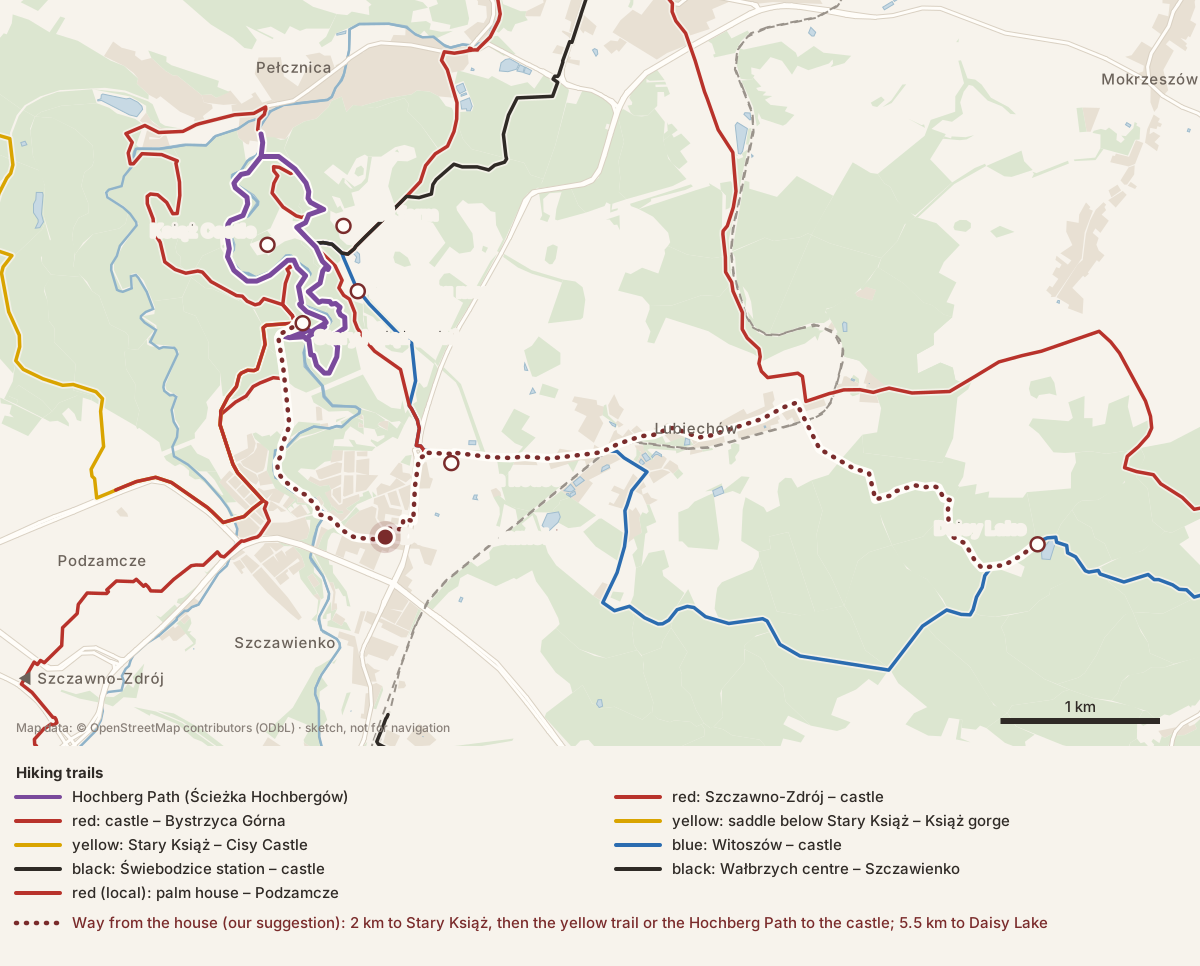
The simplest route, because from the palm house on it is waymarked all the way: a flat quarter of an hour from the house to the palm house, where you join the green Piast Castles Trail (Szlak Zamków Piastowskich) — along ul. Lubiechowska, then a forest path uphill to the ruin: 1.9 km, 25 minutes, 60 metres of climbing. If you know the area, cut the corner: ul. Zdrojowa and ul. Jaworowa to the end, a path down to Lubiechowska and on along the green trail — 2 km, but the first 700 metres are unmarked. The third option starts at the sixteenth-century church of St Anne in Szczawienko, 900 metres from the house: a hundred metres further on you pick up the red walking path, which leads through the woods straight to the ruin. All three are on our map below, and you can download the GPX file underneath it.
A fake ruin on a real castle
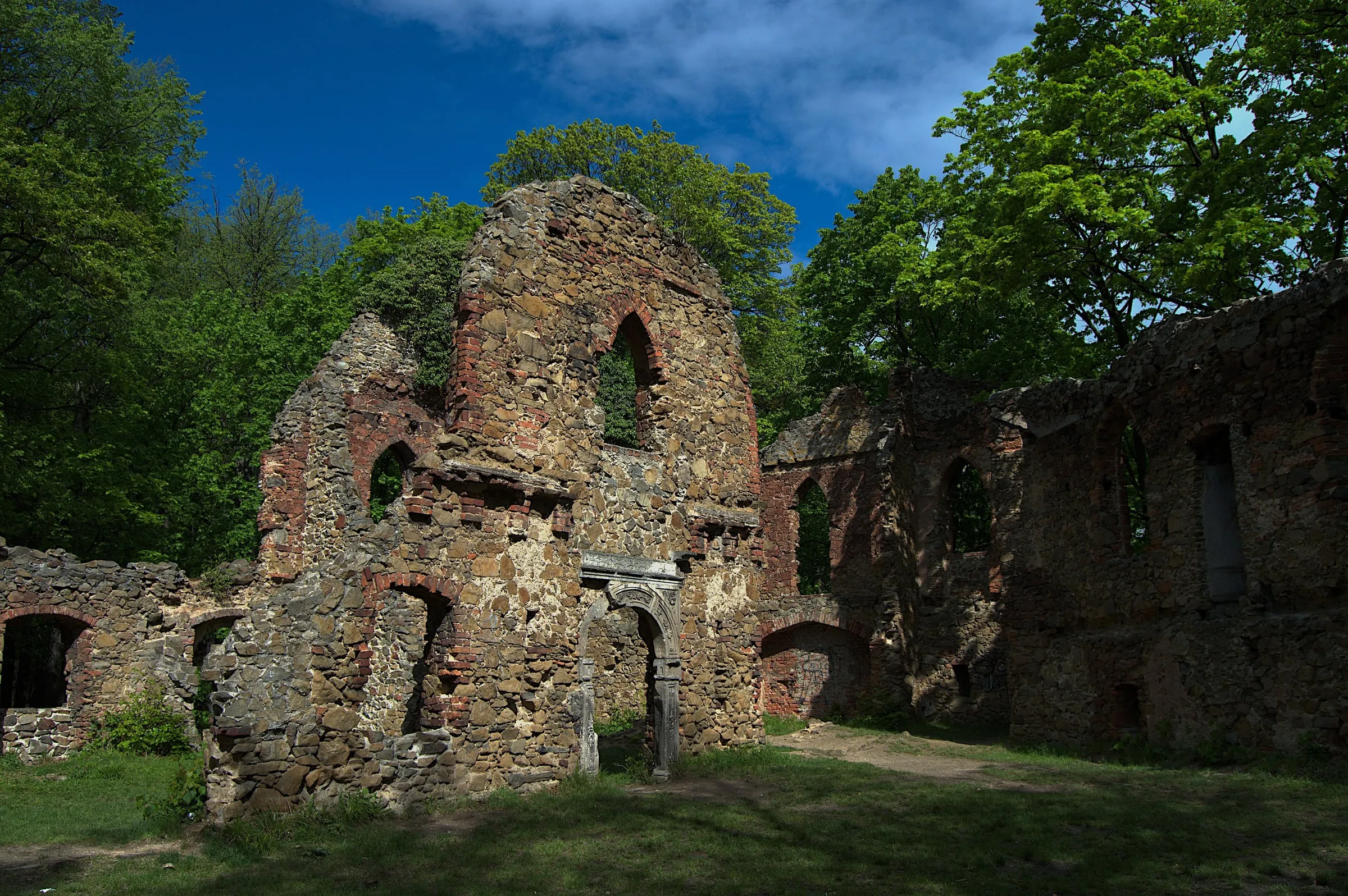
A hillfort stood on this rocky spur as early as the ninth or tenth century, and later a stone castle. Whether this is where Bolko I the Strict built his first stronghold at the end of the thirteenth century, before moving it to the rock on the other side of the gorge, or whether it was only a watchtower, historians still argue; as the crow flies, the two castles are just a few hundred metres apart. In the Hussite era robber knights are said to have holed up here, and at the end of the fifteenth century the castle was razed. From 1509 the land belonged to the Hochbergs, and in 1794–1797 Hans Heinrich VI had a romantic “ruin” built on the old walls to designs by Christian Wilhelm Tischbein: with a moat, a gateway with two turrets, a great hall, an armoury, a chapel, a courtroom, a prison with a torture chamber and a dungeon that dated back to the medieval castle. It was meant as a piece of knightly scenery facing the family seat, and for a long time that is all anyone took it for; only archaeological research at the end of the twentieth century confirmed that a real ruin lies beneath the fake one.
Legends and lore
The legend of Książ: the black stone that won a castle
Legend has it that a young squire called Bolko got lost in these forests and, in a beautiful spot, found a black stone — coal. He took it to the king, who let him build a castle as a reward. Another version has a knight called Funkenstein, who in 933 supposedly brought the Saxon ruler Henry the Fowler a sack of coal dug from the forest, was ennobled for it and told to guard the “black treasure” from a stronghold in Silesia. Neither version says which side of the gorge it stood on. History is more prosaic: Bolko I's castle went up in 1288–1292, and coal mining here began much later. Yet on one thing the legend was spot on — the Hochbergs later built their fortune on Wałbrzych coal.
Silesia's last tournament, and a restaurant in the ruin
On 19 August 1800 the courtyard of Stary Książ hosted a tournament in honour of King Frederick William III and Queen Louise, regarded as the last knightly tournament in Silesia. Members of the leading Silesian families took part in knightly costume, each with a squire and a horse, and the queen decorated the winners with orders on sky-blue sashes. After that the ruin was anything but deserted: right up to the end of the Second World War it was a popular day out, with a restaurant, four guest rooms and part of the Hochberg collections — according to the castle, even Karl May, author of the Winnetou novels, dropped in. In 1945, after the war had already ended, Red Army soldiers set fire to the building. What is left is a shell: walls with pointed-arch windows of red brick, two Renaissance portals brought from other buildings (one from the demolished palace at Trzebień near Bolesławiec) and the remains of the chapel with its small round tower. Look for the ivy climbing the walls: it is a protected specimen within the reserve, with a trunk 82 centimetres round.
The loop on the Hochberg Path to Książ Castle
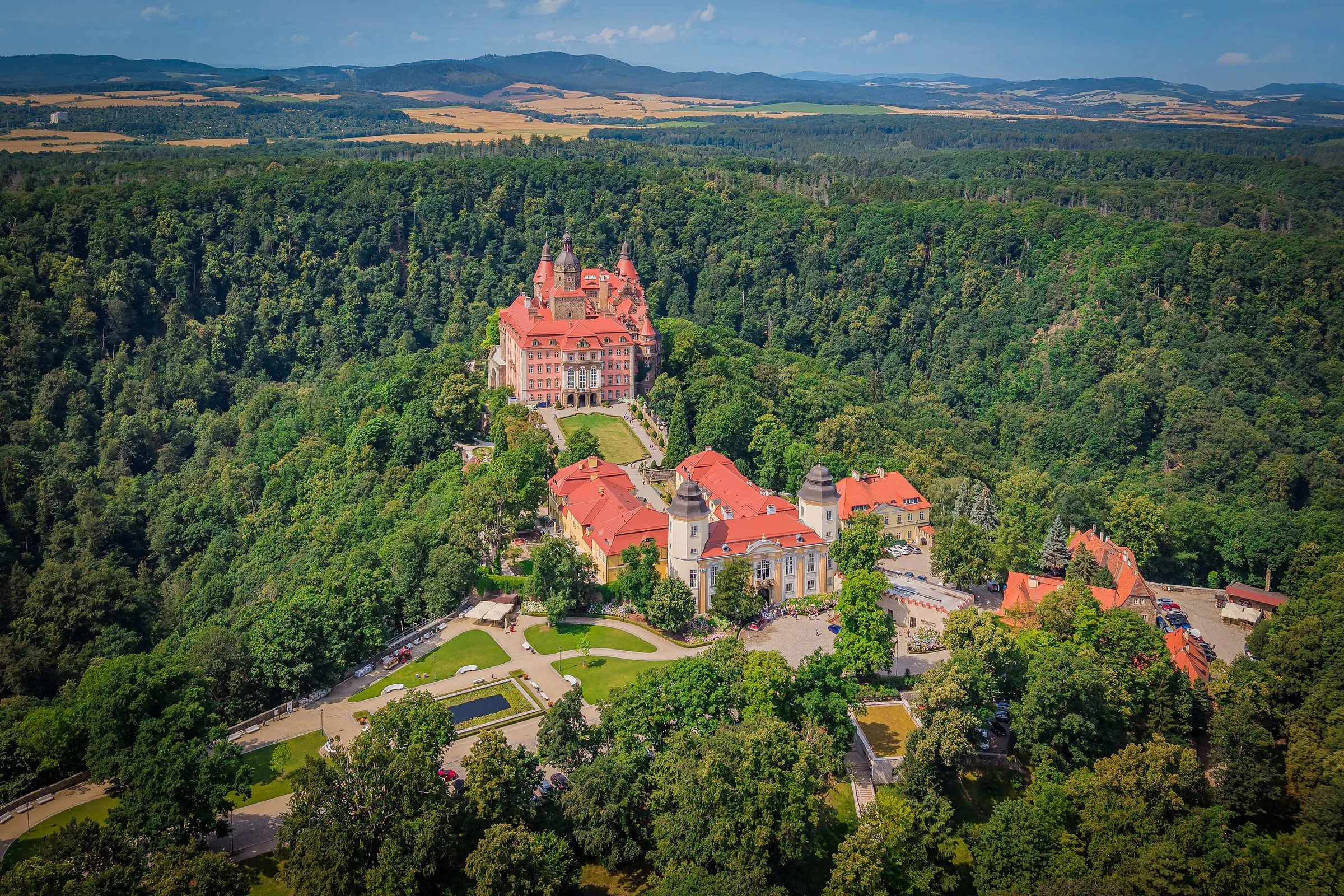
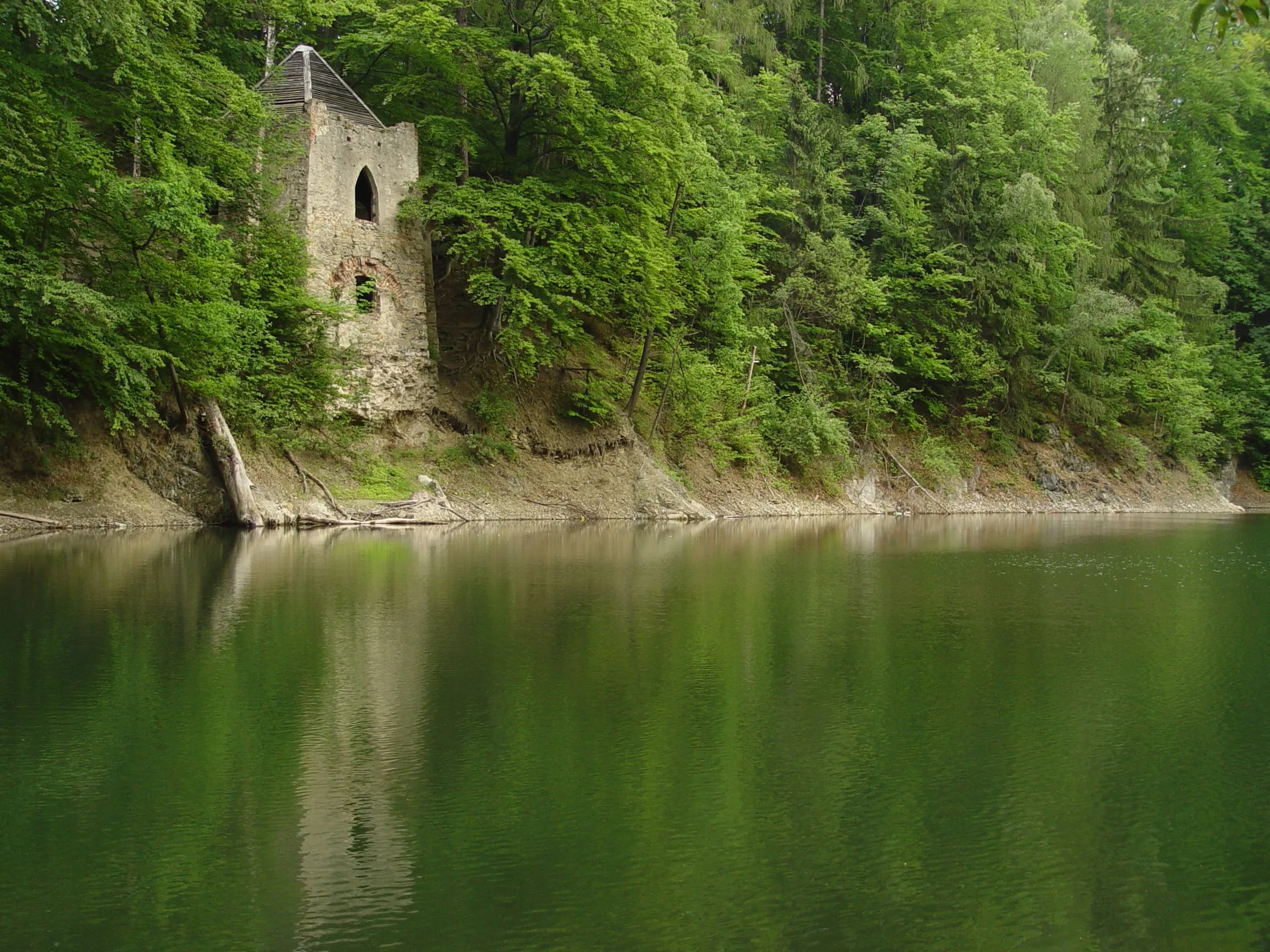
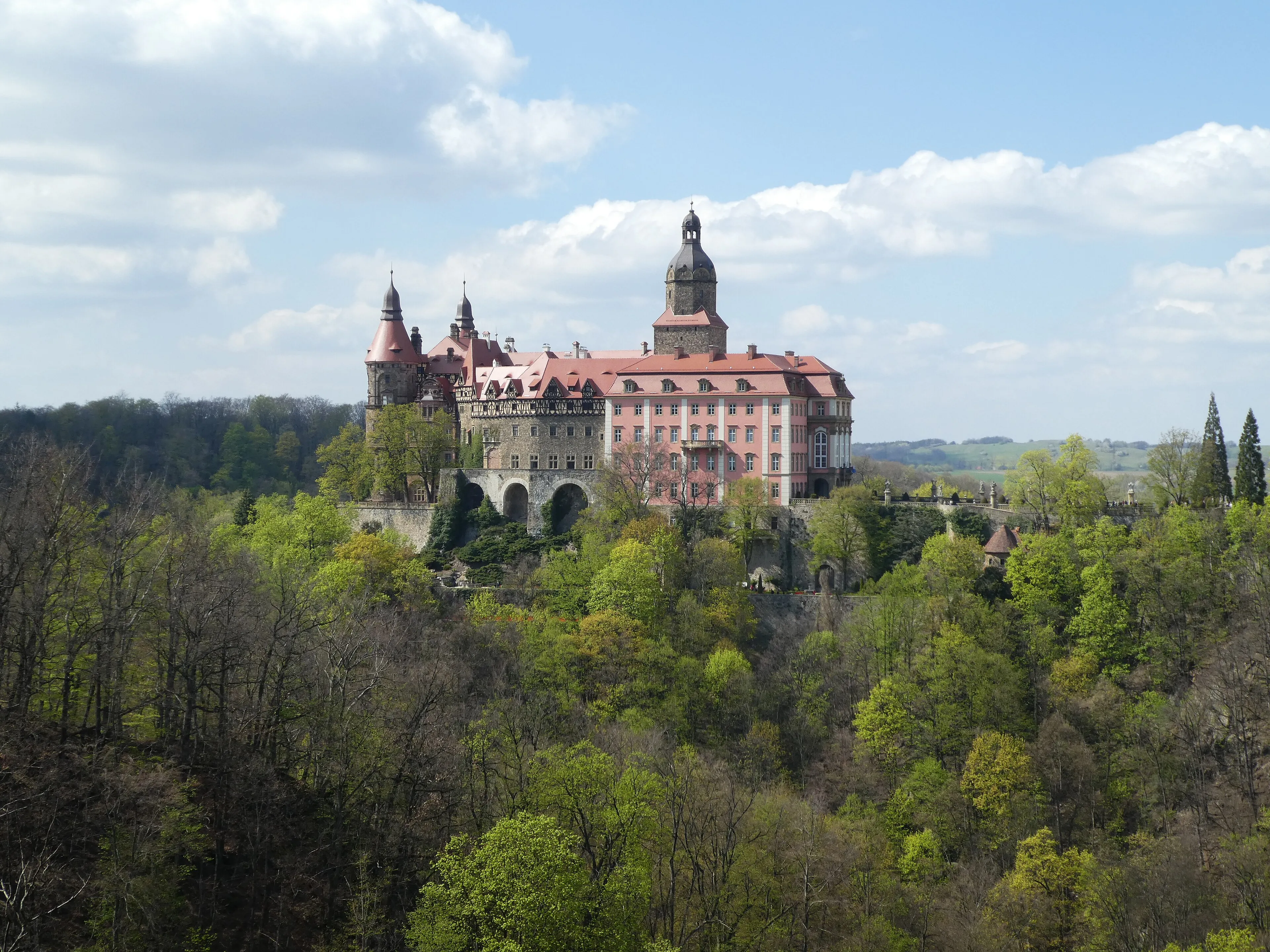
Before you head down, stop at the viewpoint by the path: from here you can see Książ Castle across the gorge. There is also a view from the tip of the rocky spur, but there are no railings there, so keep back from the edge. From the junction by the ruin you go down to the Pełcznica on the yellow trail (900 metres, 86 metres of descent) or the shorter red one. Waymarked trails and the Hochberg Path (Ścieżka Hochbergów) run along the floor of the gorge: wooden walkways above the drop, passages between the rocks, steps, and information boards on the area's nature and history. You pass Łabędzi Staw, the Swan Pond — the pond itself has gone, but on what was once its island stand the remains of a funerary monument that Tischbein designed for two sons of Hans Heinrich VI who died in early childhood. Further on is the Bolko Yew (Cis Bolko), one of the oldest yews in the Sudetes: Humboldt put it at eight hundred years, today it is reckoned to be about six hundred. It is a female tree, so strictly speaking it ought to be “Bolkówna” — Miss Bolko. From there the red-and-green trail climbs to Książ Castle (700 metres). You come back by our usual route — twenty minutes through the woods past the stud farm — or the longer way: along ul. Piastów Śląskich and down Aleja Rodziny Hochbergów to the palm house (2 km, about 25 minutes), then a quarter of an hour home. The whole loop is about 7.5 km and two hours of walking without stops.
Before you go down into the gorge
Walking boots: the gorge paths are narrow, with steps and walkways above the drop, and slippery after rain and in fallen leaves. This is the “Przełomy pod Książem” nature reserve, and the Hochberg Path has rules set by the forestry office: dogs on a lead only, stay on the trail, no bikes or other wheeled vehicles — and you could not get a pushchair over the steps and narrow walkways anyway. The path is open from dawn to dusk, but not when there is snow on the ground, in strong wind, heavy rain or a thunderstorm; sections closed for forestry work are marked with a “ZAKAZ WSTĘPU” (no entry) sign or a red flag. In September 2023 part of the path between Stary Książ and the Swan Pond collapsed; in November 2025 the forestry office started repairs. Before you set off, check the forestry office's news page to see whether that section has reopened; if not, follow the diversion signs on the spot. The ruin has not been made safe — high walls above the drop, no railings, and cellars you should stay out of. With small children it is better to keep to the top, to the ruin and back; after rain, look out for fire salamanders, but do not touch them. In an emergency call 112; the forestry office's number is +48 74 888 05 60.