- Distance
- about 4.4 km to the pump room, ul. Kościuszki 23
- Getting there
- about an hour's walk on the flat, or by city bus; 10–12 minutes by car, with parking on aleja Spacerowa and elsewhere
- Time to allow
- from an hour for the hall and pump room to a full day with Chełmiec
- Good for
- a walk without the car, rainy days, the evening after the castle
- With children
- a playground in the Swedish Park, free quest trails, a lookout tower with a ramp for pushchairs and, when it rains, a pool with a paddling area
The pump room and promenade hall: four waters to taste
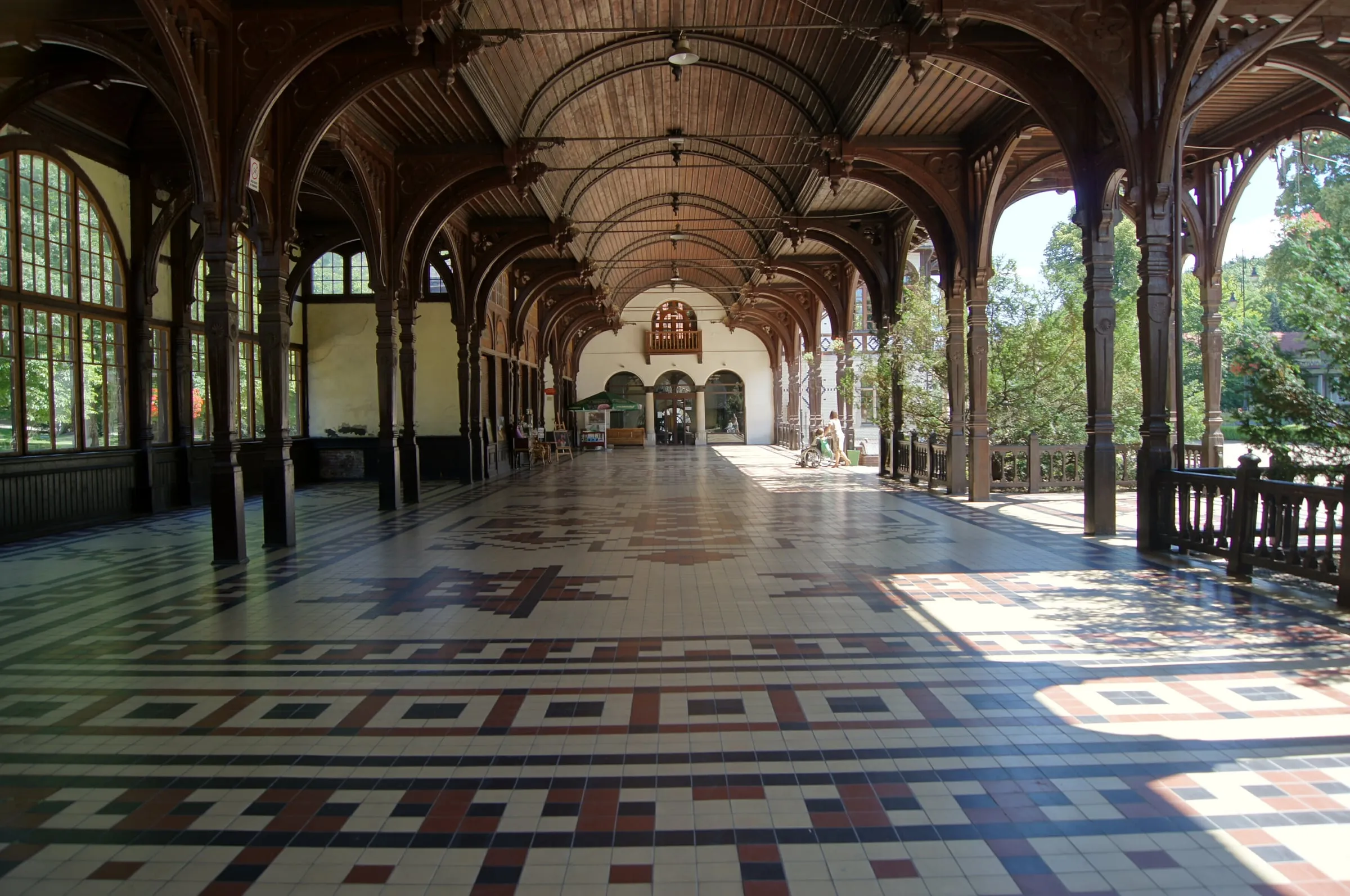
The covered promenade hall was built so that spa patients could walk from spring to spring whatever the weather. The first one, the wooden Elisa's Hall (Hala Elizy), was designed in 1830 by Joseph Raabe — a Silesian painter who in 1811 had stayed with Goethe in Weimar and painted his portrait twice. It burnt down in 1893 together with the pump room; today's hall, of timber and masonry, was completed in 1896. In the pump room you can taste four waters every day: “Mieszko”, “Młynarz”, “Dąbrówka” and “Marta”. All four are naturally carbonated waters rich in bicarbonate and sodium, but each has a different mineral make-up, so start with small sips and compare. The pump room is open to everyone, not just spa patients; bring your own cup or ask about one when you get there. There is a short maintenance break in the early afternoon — the pump room's page has the times.
The water that was ordered as far away as China
People were drawing water here long before there was a spa: near the escarpment on which Anna's Tower (Wieża Anny) stands, a mineral-water well almost 2,000 years old has been found. In the first written mention, from 1221, the settlement is called “Salzborn”. That sounds like “salt spring”, although the spa's own chronicle tends to derive the name from the surname of the man who founded the village — and the water is not salty at all. It is szczawa, naturally carbonated water, and that is where the Polish name Szczawno comes from. The most famous spring was the Mühlbrunnen, found in 1790 on land belonging to the miller Demuth and known since 1945 as “Młynarz”, the Miller. Between 1816 and 1840 some 2.5 million bottles of its water were reportedly sent out; it was in demand all over Europe and even in America and Asia, and in 1825 an order arrived from China.
The Spa Theatre and, next door, the White Hall where Wieniawski caused a sensation
The Spa Theatre at ul. Kościuszki 19 has stood since 1896: a neoclassical façade outside and, inside, a richly decorated neo-rococo auditorium with gilding. Right next door, in what is now the White Hall (Biała Sala) — the old spa assembly room, also designed by Raabe — the twenty-year-old Henryk Wieniawski played on 16 August 1855; the newspaper “Gazeta Warszawska” reported that he had been a sensation. Today the theatre is named after the violinist, and a festival bearing his name has been held since 1966, usually in June. You can hear Wieniawski here without a ticket, too: every day at noon and at 8 pm his “Polish Song” (Pieśń polska) rings out from Anna's Tower, built in 1818 and another of Raabe's designs.
Princess Daisy's Grand Hotel and a Nobel laureate's birthplace
A few minutes from the hall, at ul. Kolejowa 14, stands the former Grand Hotel, opened in 1910 by Hans Heinrich XV von Hochberg. The furnishing of the interiors was overseen by his wife, Princess Daisy, who during the First World War set up a hospital for wounded soldiers here, just as she did at the castle. The Grand Hotel in Sopot, built in the 1920s, is said to be a copy of it. Today it is the Dom Zdrojowy sanatorium, and its grand rooms still host cultural events. You can step inside just for a coffee: one of the rooms is home to the Daisy Cafe. The second address is the “Korona Piastowska” sanatorium, formerly the “Zur Krone” hotel, which was run by the Hauptmann brothers' parents. Carl (1858) and Gerhart (1862), winner of the 1912 Nobel Prize in Literature, were both born there; you can view the building from outside.
Churchill in Szczawno-Zdrój: did he stay at the Grand Hotel?
Local lore in Szczawno has it that Winston Churchill once stayed at the Grand Hotel, and the town's website lists him among the hotel's guests. There is a genuine family connection behind the story: Princess Daisy's brother, George Cornwallis-West, was married from 1900 to 1914 to Jennie, Churchill's mother — and was only sixteen days older than his stepson. What is documented is Churchill's attendance at the Kaiser's manoeuvres near Wrocław (then Breslau) in September 1906, four years before the hotel opened. Nobody has yet produced a document giving the date of a visit to Szczawno, so enjoy it as a good anecdote rather than a fact.
Parks, towers and a plan for rainy days
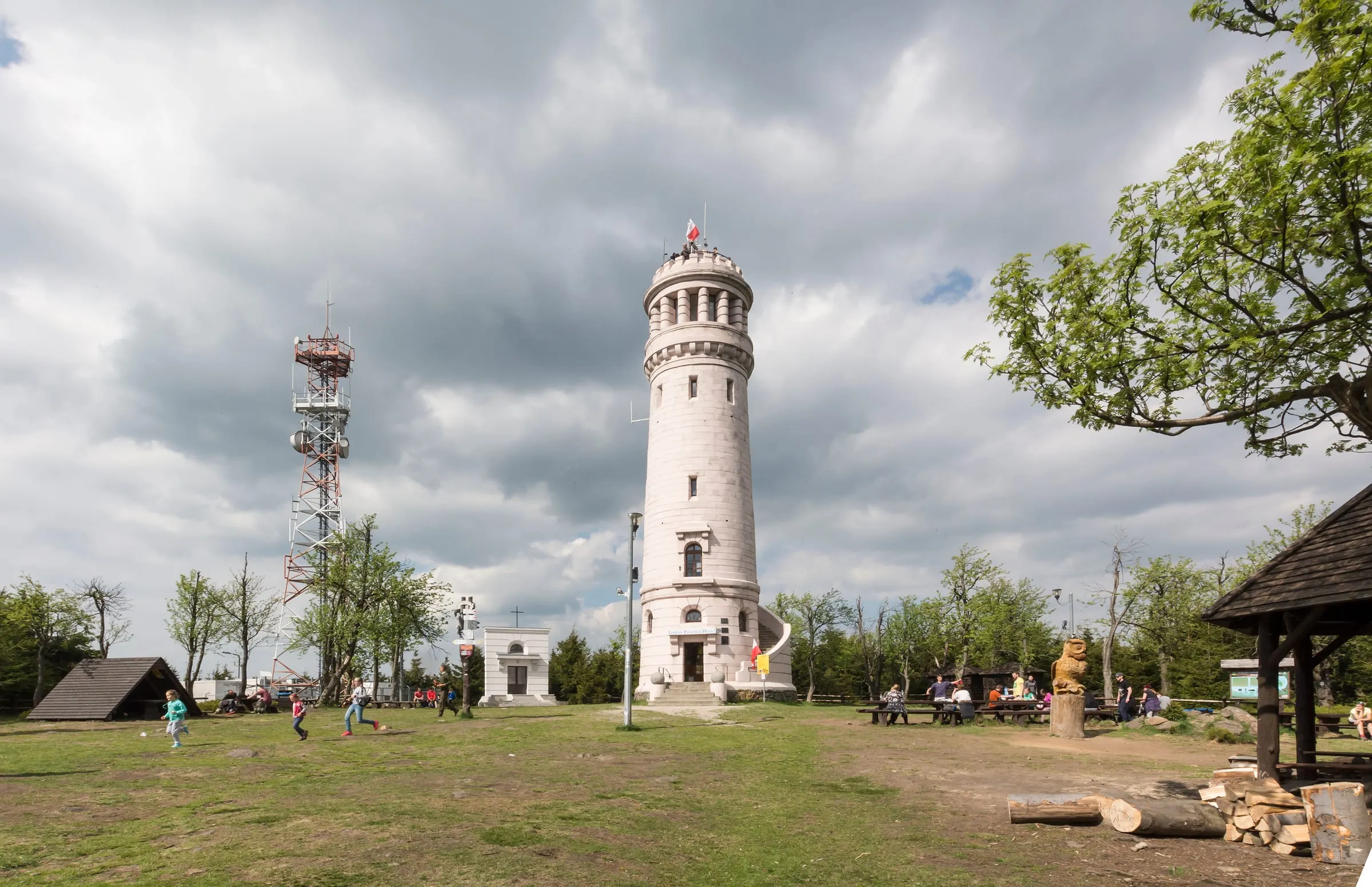
Above the hall the Spa Park (Park Zdrojowy) climbs the slope with its bandstand, and beyond it lies the Swedish Park (Park Szwedzki): ponds with fountains, a large playground built from natural materials and some remarkable trees, including a cork oak and a swamp cypress whose breathing roots poke up out of the ground. For children there are two free quests, trails with riddles and a treasure at the end; leaflets are available at the Dom Zdrojowy reception, among other places, and with the free app “Questy – Wyprawy Odkrywców” you can play without a leaflet. On Gedymin Hill (Wzgórze Gedymina) a 30-metre lookout tower has stood since 2022, with a spiral ramp and no stairs — you can take a pushchair up, and on a clear day you can see the Karkonosze (Giant Mountains) and Wrocław's Sky Tower. For a full day out there is Chełmiec (850 m): from the pump room, take the black trail for a gentle climb or the blue one, shorter but steep; the stone tower on the summit opens at weekends in season. If it is pouring, there is still the spa's indoor pool, “Delfinek”, at ul. Słoneczna 1, with a children's paddling area: anyone can buy a ticket, not just spa patients — and the same goes for some of the treatments.