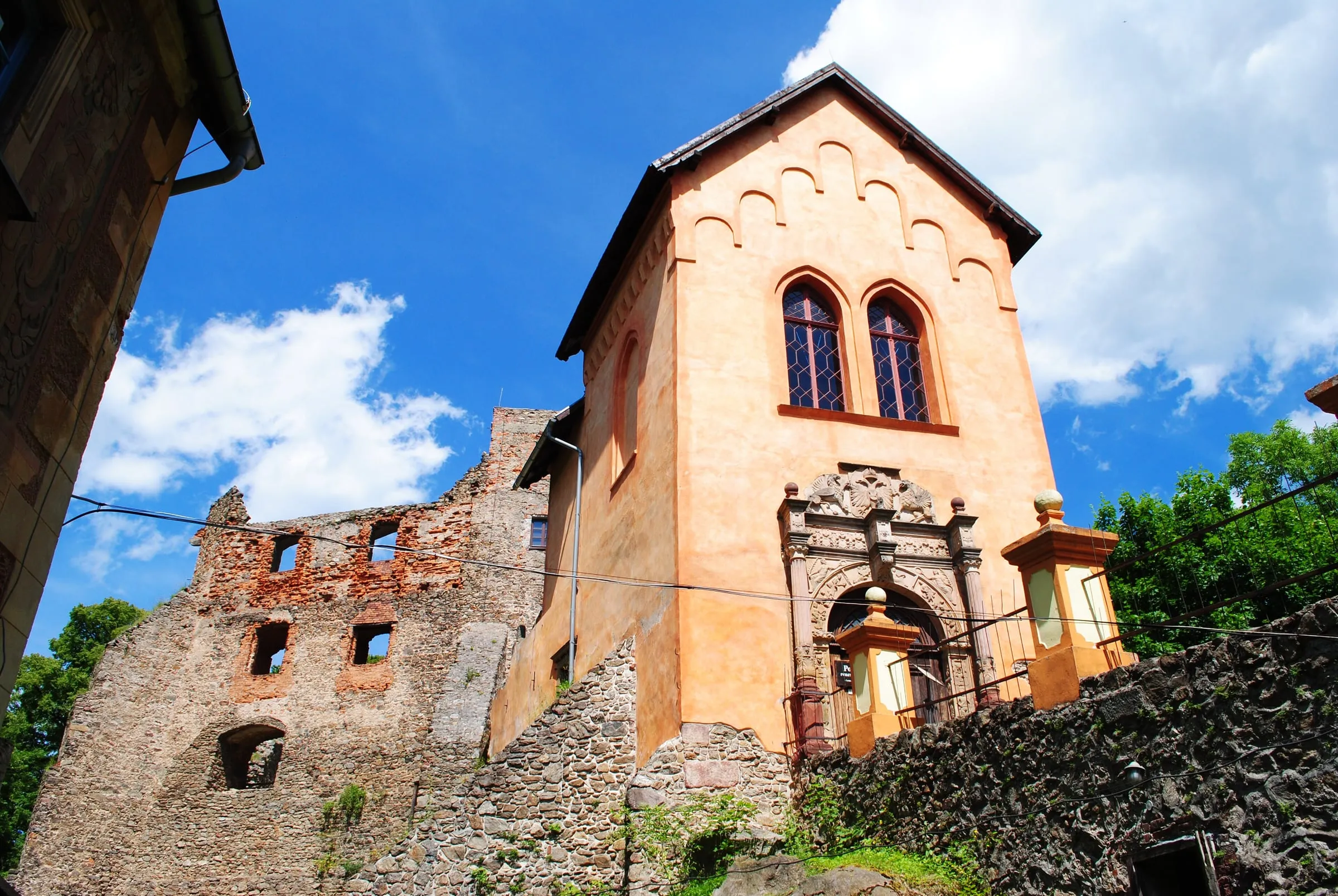
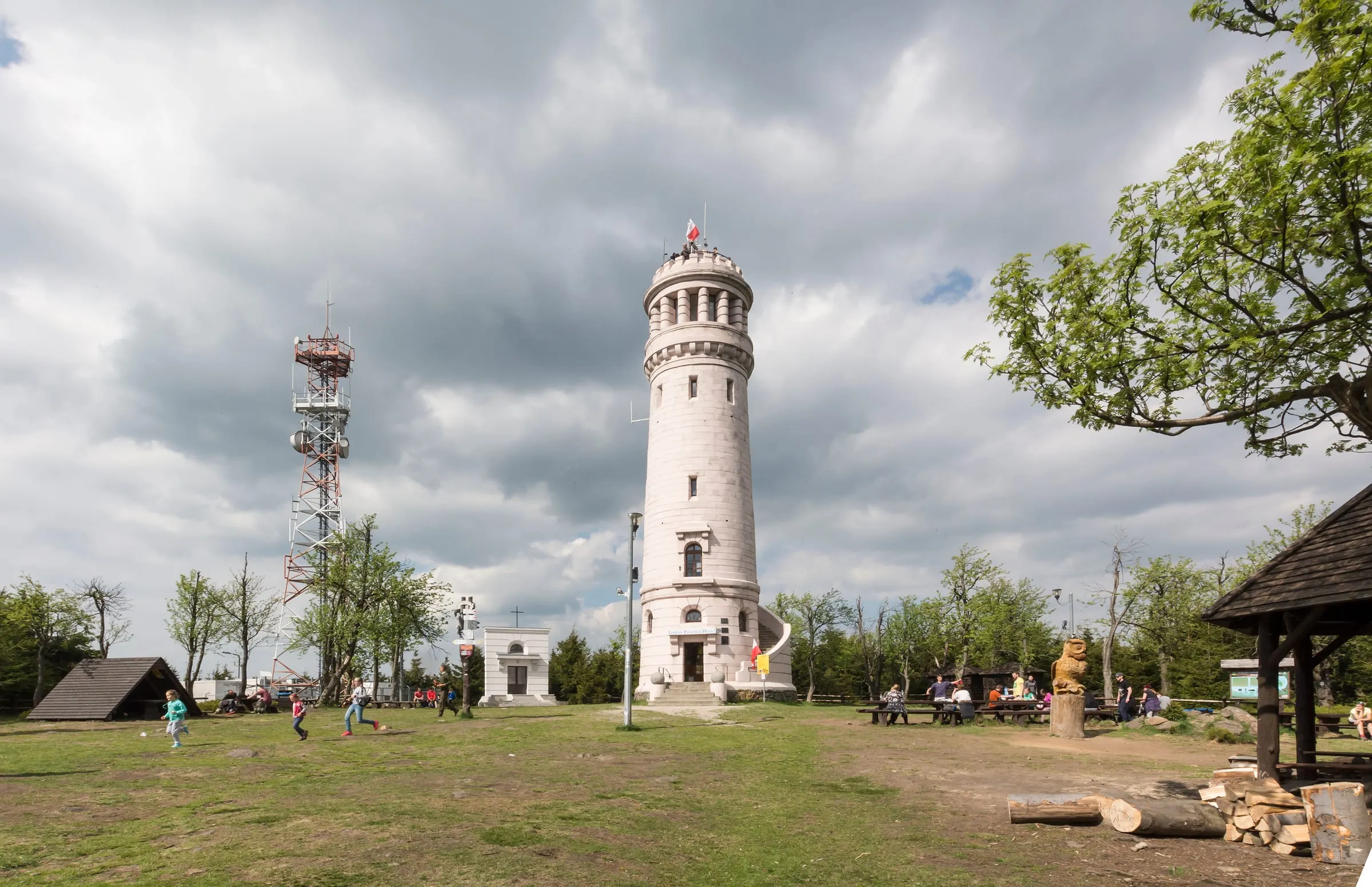
A medieval castle that came within a whisker of being demolished in 1823, perched on a rock above the Bystrzyca reservoir, and behind it Wielka Sowa with its lookout tower of 1906. A day in the Owl Mountains, about half an hour by car from us.
Distance
Grodno Castle about 17 km (Zagórze Śląskie), Wielka Sowa about 25 km
Getting there
by car via Jedlina-Zdrój, half an hour to Zagórze; from the car park another 10–15 minutes’ walk uphill
Time to allow
the castle (tour about 1 h 10 min) and the lake take half a day; with Wielka Sowa, a full day
Good for
a clear day, in walking boots; Wielka Sowa: children of school age and up; in the rain: the castle and the Akwarium
Dogs
at the castle, only the lower courtyard; on Wielka Sowa, on a lead and muzzled; no animals up the tower
Robber knights, the Logaus and a bolt of lightning: seven centuries on Choina
Grodno stands on the summit of Choina (450 m), above the Bystrzyca gorge. The hill’s name is an old word for a conifer, and the castle’s old German name, Kynsburg, also harks back to the coniferous forest. Its construction is attributed to Bolko I the Strict; the earliest surviving document mentioning it dates from 1315, and in the 15th century the castle became a nest of robber knights — from 1443 to 1450 it was the base of Georg Mühlheim, known as Puschke. In the 16th century it belonged for a time to the Hochbergs of Książ, and Matthias von Logau and his son Georg turned it into a Renaissance residence: the lower courtyard with five bastions, the gate with its sgraffito, a bakery and a bathhouse. The bills proved too much for them — towards the end of the 16th century Georg’s widow, deep in debt, had to leave the castle with her children for good. In the Thirty Years’ War the Swedes captured Grodno and partly destroyed it; in 1689 the tower burned out after a lightning strike, and from 1774 only servants lived here.
A ruin under the hammer: who saved Grodno
In 1789 part of the walls collapsed, and in 1823 local peasants bought the ruin at auction to pull it down. They were stopped by Johann Gustav Büsching, a professor from Wrocław (then Breslau): after his protests a court granted him the use of the castle for life, and from 1824 the walls were made safe — not always with much regard for history. Between 1860 and 1907 Baron Maximilian von Zedlitz ran a restaurant and a museum here, and Kynau, today’s Zagórze Śląskie, became a summer resort, all the more fashionable once the railway and the dam were built. Paul Keller wrote the castle into his novel “Waldwinter” under the name Waldhof, and in 1936 part of the film adaptation was shot here. The Zedlitz family owned Grodno until 1945. In 1965 the Wałbrzych branch of PTTK, the Polish tourist society, opened a museum in the castle, and archaeologists are still digging here today — one of the most interesting finds of recent years is a bulla, the lead seal of a papal document, issued by the antipope Benedict XIII.
Legends and lore
The legend of Grodno Castle: the skeleton in Margaret’s dungeon
Legend has it that Margaret, the castellan’s daughter, loved a poor squire, but her father picked a rich older suitor for her. In one version she pushed the unwanted suitor off a precipice; in another, she pushed the old husband forced on her off the walls during a morning walk. Her father, so the story goes, saw it from a window and had her walled up in the dungeon, where she starved. A woman’s skeleton was reputedly found there in the 20th century. None of it is documented, and the versions disagree, yet “Princess Margaret’s dungeon” is a fixture of the tour, with a skeleton chained to the wall. A castle director once told the press there are no ghosts here — the guides tell every group the story anyway.
Visiting Grodno Castle: guided on weekdays, on your own at weekends
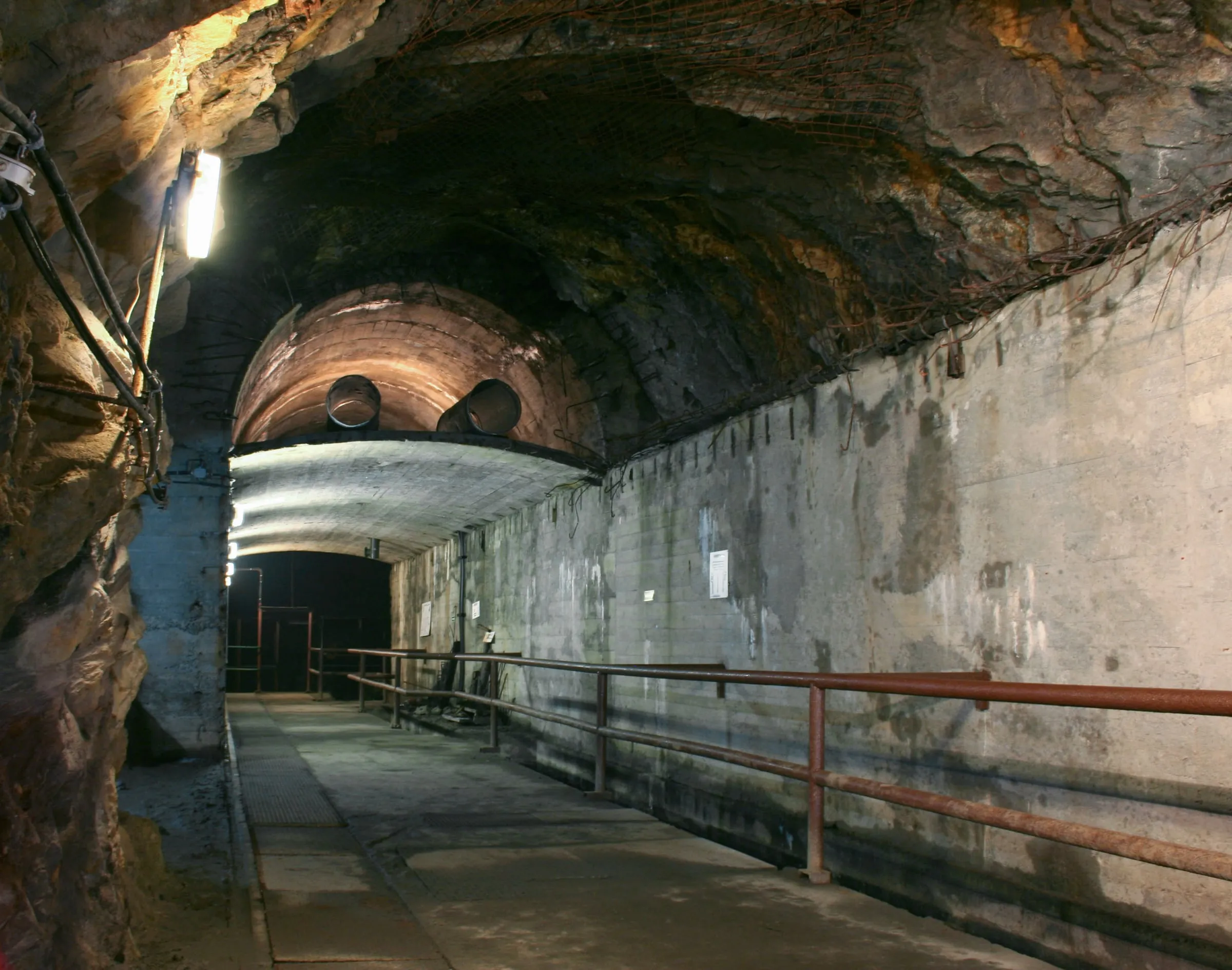
You can’t drive right up to the castle, because Choina is a nature reserve. Leave the car at one of the free car parks below the hill (you pay at the one by the Akwarium) and allow 10–15 minutes on foot up an unsurfaced path; after rain it can be muddy, and with a pushchair it is hard going. From Monday to Friday you tour the castle with a guide, included in the ticket price. On Saturdays, Sundays and public holidays you go round on your own, and for an extra charge you can take an audio guide in Polish, English, German or Czech — useful if anyone in your group doesn’t speak Polish. The tour takes about an hour and ten minutes and includes the torture chamber, Margaret’s dungeon, the Knights’ Hall and the Hunting Hall, as well as a multimedia room with a small cinema. With a dog you can only go into the lower courtyard, which needs no ticket; that is also where you’ll find the Karczma Rycerska tavern. If you are also heading to the Walim Adits at Rzeczka, buy the cheaper combined ticket.
Jezioro Bystrzyckie: a village on the lake bed and a footbridge over the water
Below the castle lies the Bystrzyca reservoir, Jezioro Bystrzyckie. A dam more than a hundred years old, with a stone wall 44 metres high, holds back the Bystrzyca here to form a lake over three kilometres long and up to 30 metres deep. The village of Śląska Dolina (Schlesiertal) disappeared beneath the water; when the lake was drained in 2016 to repair the dam, its remains came to light again. The best place to start a walk is the Akwarium, the visitor centre on ul. Wodna in Zagórze: inside is a large freshwater aquarium — a good place to spend a rainy hour with children — and from here paths lead to the footbridge, the castle, the dam and the viewpoints. Today’s footbridge, 126.5 metres long, opened on 13 August 2019; it replaced a suspension bridge from 1968 that was taken down in 2018. In the summer season the Kąpielisko Słoneczne bathing area on ul. Wodna may be open — check before you set off.
Wielka Sowa and its former Bismarck tower
The highest peak of the Owl Mountains stands at 1,015 metres and belongs to the Crown of Polish Mountains. The concrete tower on the summit opened on 24 May 1906 as a Bismarck tower: inside stood a bust of the chancellor, the windows held three stained-glass panels showing scenes from his life, and an acetylene searchlight shone from the top. In its first year some 21,000 people climbed it. From the terrace at the top of the 25-metre tower the view stretches from Śnieżka to Śnieżnik and Ślęża. In season the tower is open every day (for shorter hours on weekdays), out of season only at weekends, and in bad weather it may be closed; children under 16 must be accompanied by an adult, and animals are not allowed up at all. With a pushchair, take the route from the Walimska Pass (Przełęcz Walimska): 6.4 km each way, mostly on a wide gravel track (only the last kilometre is harder), with a free car park at the start. Shorter climbs, walking times and car parks are covered under Wielka Sowa on our mountains page.
Before you go, check the castle’s opening hours, closed days and tickets at zamekgrodno.pl and the season and rules for the Wielka Sowa tower at wielkasowa.eu; the cheaper combined ticket with Rzeczka is explained at sztolnie.pl.