The guided tour: chains under the ceiling and winding engines from 1911
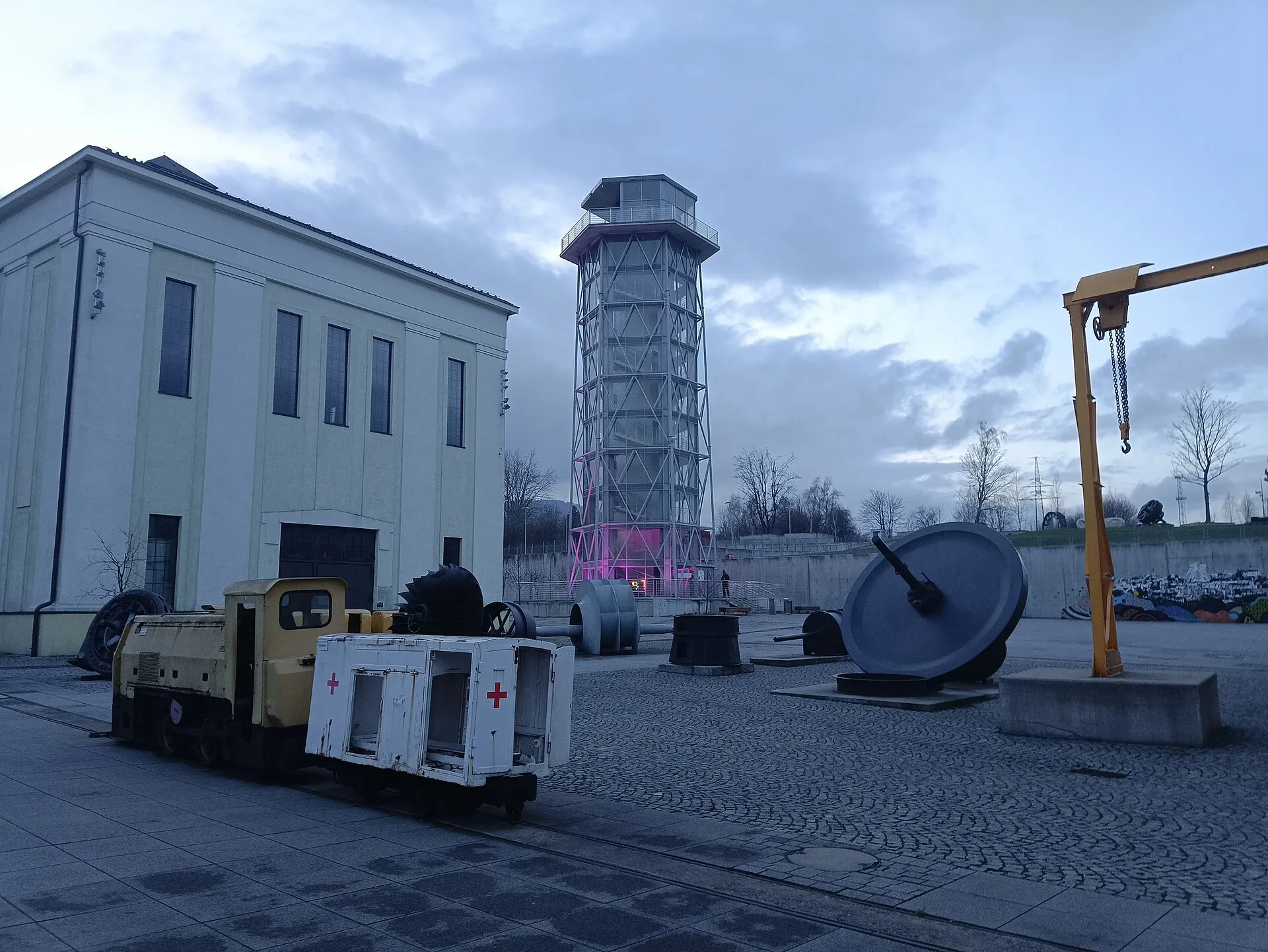
The buildings and the underground route can only be seen on a guided tour. Groups set off on the hour from the ticket desk in the Welcome Center, the old shift foremen's building, and the whole visit takes about 100 minutes. The guides are former Julia miners, so feel free to ask what their shifts were like. A guide in English or German has to be booked in advance; otherwise there is an audio guide in those languages or in Czech. In the chain bath the miners hoisted their clothes up to the ceiling on chains because — as the guides explain — in lockers they never dried and simply rotted. Then come the lamp room, the forge with its display of machinery, and the engine house of the Julia shaft, with two winding engines that ran from 1911 right up to the mine's closure. The tour usually ends on a glass viewing tower about 25 metres high, looking out over the whole site and the Wałbrzych Mountains. Afterwards, have a coffee in the Sztygarówka café, among photographs of the mine as it looked before restoration.
The underground route: shallower than you might think
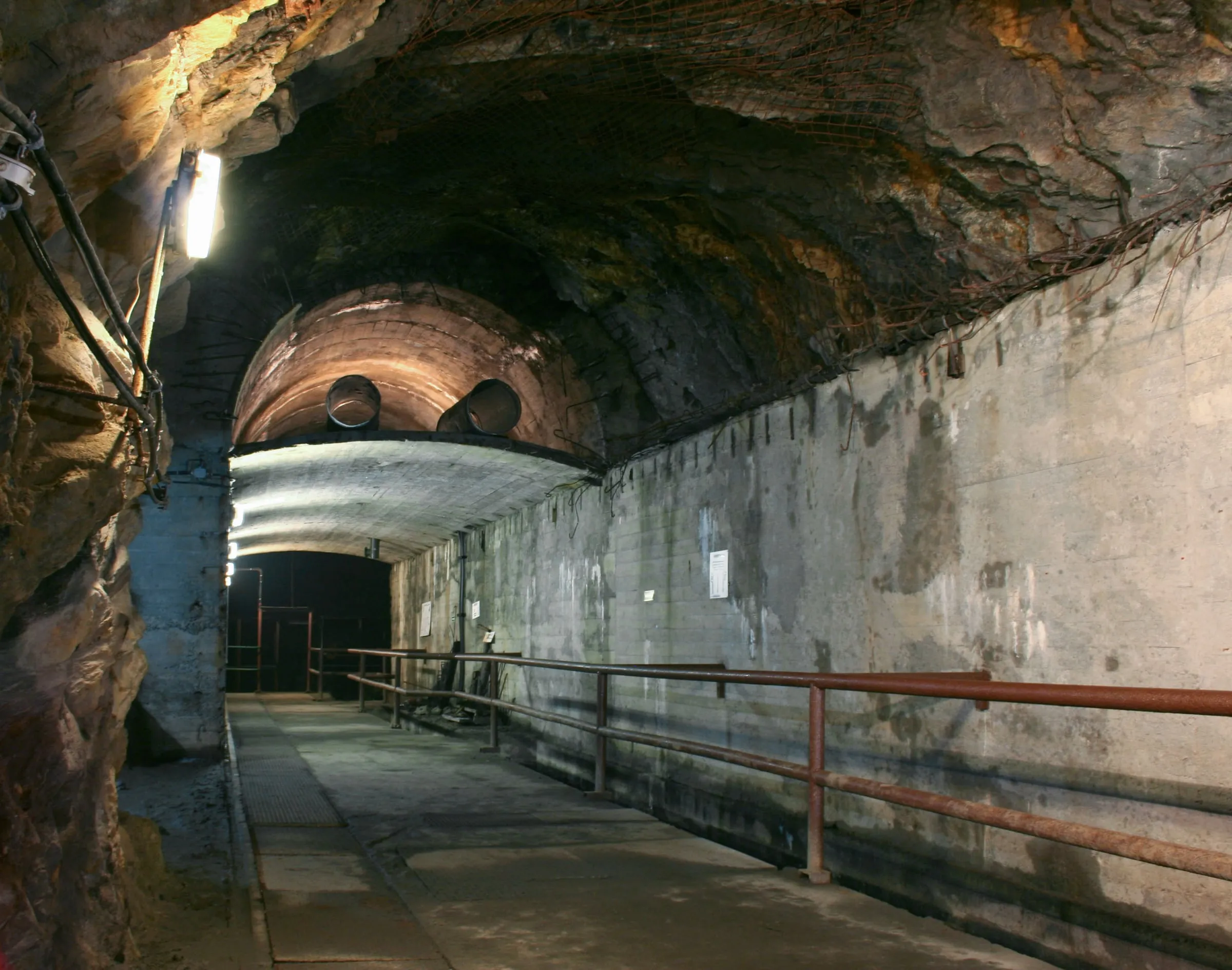
The underground route covers a few hundred metres of a former training adit and a stone haulage gallery, with the machines once used to cut and load the coal. To be honest: you do not ride a cage down a shaft deep into the earth. The passage runs close to the surface, and Julia's real workings were filled in and flooded long ago, so if you are expecting a mine like the ones in films, you may come away wanting more. It can be chilly, so bring a sweatshirt, and wear closed shoes because the floor is uneven. If you have children with you, decide together before you buy tickets whether they want to go into a narrow, dimly lit passage. For younger ones there is SOWA on site, a science zone with 18 hands-on experiment stations (it is sometimes closed on Saturdays, so check before you come), and afterwards you can go round town looking for the Wałbrzyskie Gwarki, little ceramic figures of miners, using the map for the town trail. For anyone aged ten or over, the mine offers night tours with former miners on request: about two and a half to three hours, going underground in work clothes, with a lamp and an escape breathing set.
Fuchs, Julia, Thorez — and Julia again
Coal was being dug in Biały Kamień (then Weißstein) as early as the 16th century, and in 1770 a mine called Fuchs — “fox” — was registered here. After 1945 the name changed with the politics: Julia, then Biały Kamień, from 1950 Thorez, after the French communist leader Maurice Thorez, and from 1993 Julia once again. At the end of the 19th century almost 20,000 people worked in Wałbrzych's fifteen mines; the guides will tell you the local coal was hard to get out, but almost free of sulphur and with a very high calorific value. The last tub of coal came up to the surface on 20 September 1996. In 2004 the mine buildings were listed as a historic monument, and in 2014 they reopened as a science and arts centre, today the Centre for Science, Culture and Art. The liveliest time to come is Barbórka, the miners' feast of St Barbara: in early December the mine celebrates mining traditions with concerts and, for children, the “leap over the leather”, the old miners' initiation rite; on 4 December a miners' parade marches through the town.
The Fox Adit (Lisia Sztolnia) and the first-coal legend: royalty in a boat
Local legend has it that Wałbrzych's first coal was found on the slopes of Fox Hill (Lisie Wzgórze). Historians stick to the documents: coal mining in Biały Kamień is first recorded in 1561. The part that sounds like a fairy tale, though, is true. In 1794 the Fox Adit (Lisia Sztolnia) opened beneath the hill, the first on the Continent where coal travelled by boat, on water a metre deep. From the very start it carried visitors too: King Frederick William III and Queen Louise, Princess Izabela Czartoryska, Tsarina Alexandra Feodorovna and, in the summer of 1800, John Quincy Adams, then US envoy in Berlin and later President of the United States, who described the trip in a letter. His only link with our house is a similar surname. The adit flooded and was closed in 2002; you can see a model of it in the lamp room.
Alberti Palace: porcelain in a merchant's home
The Porcelain Museum occupies the Alberti Palace (Pałac Albertich) at ul. 1 Maja 9, two kilometres from the mine. The neoclassical house was built in 1801–1803 for a merchant named Sonnabend, to a design by a pupil of Carl Gotthard Langhans, the architect of Berlin's Brandenburg Gate. In 1834 it was bought by the Alberti family, pioneers of mechanical spinning in the town. There has been a museum here since 1926, and since 2015 it has been the Porcelain Museum: more than 10,000 pieces of Silesian and European porcelain, many from Wałbrzych's own factories. The rooms are furnished like a well-to-do family's home, so cups and vases stand among furniture and paintings rather than in rows of display cases. There is Polish painting too, including Duda-Gracz, Nowosielski and Beksiński, Polish ceramics from the 1950s and 60s, and in the garden stoneware buffalo, wolves, a panther and a bear by Domicella Bożekowska. There are no guided tours, but the audio guide also comes in English, German, Czech and Ukrainian. The museum lets in groups of up to 20 people every half hour, so buy a ticket for a set time online in advance. Animals are not allowed inside, so if your dog has come with you, take turns going in.
A stroke instead of a sceptre: Wałbrzych porcelain and hands-on workshops
Coal and porcelain are two halves of the same story. In 1831 the porcelain painter Carl Krister took over a Wałbrzych workshop and set about imitating Berlin's Royal Porcelain Manufactory: its style and very nearly its mark, with a vertical stroke where Berlin had its sceptre. Later he added the letters KPM as well — for “Krister Porzellan Manufaktur” — and defended them in court. In 1845 Carl Tielsch followed his example and founded a factory in Stary Zdrój (then Altwasser), which twenty years later employed more than 1,500 people and in 1906 installed a 64-metre coal-fired tunnel kiln. Szczawienko, our part of town, had a factory too: from 1882 to 1930 Hermann Ohme's works shipped its “Old Ivory” tableware mainly to the USA and Britain, and collectors hunt for it today. The old Tielsch works, as the “Wałbrzych” factory, lasted until 2012, and the last of them, “Krzysztof” — formerly Krister — stopped production at the end of 2022 after 192 years, because of gas prices. Some of its working moulds are still in use at the Centre for Unique Ceramics (Centrum Ceramiki Unikatowej) on the Stara Kopalnia site. The centre belongs to the Porcelain Museum and runs workshops where you decorate “Kristoff” figurines cast in those very moulds. Anything you make on the potter's wheel or from clay can only be collected three weeks later, so on a short stay you are better off painting porcelain, plaster or glass, which you take home the same day. To book, call +48 74 667 09 21.
Opening hours and prices change with the seasons, so before you set off check tour times and tickets on the Stara Kopalnia website, the opening hours of the Porcelain Museum and the rules of the Explore Wałbrzych combined ticket.